Slovenian president on screening of a new documentary "Eyes and Ears of God"
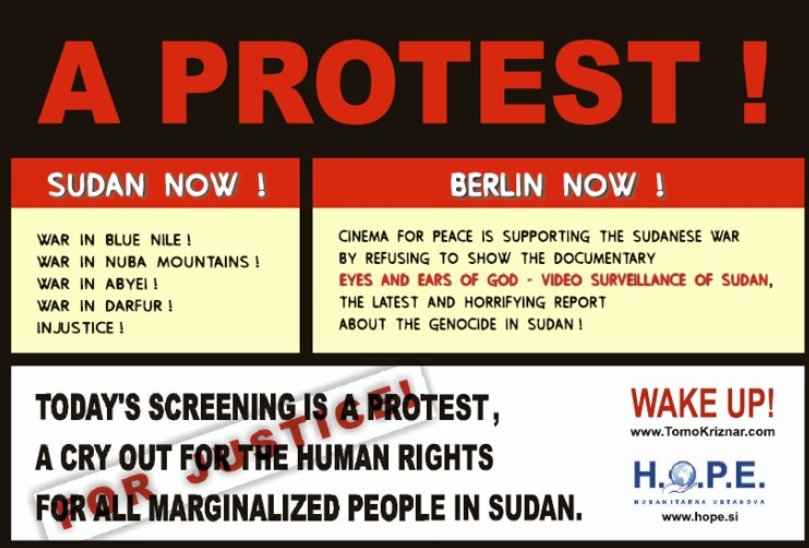
The President of the Republic of Slovenia, Dr Danilo Türk, attended the screening of a new documentary “Eyes and Ears of God – Video Surveillance of Sudan”.
Report from Eyes and Ears volunteers from Blue Nile region of Sudan (4.3.2012)
Urgent appeal – IDPS in BLUE NILE started dying of hunger
IDPs /refugees/ in Blue Nile and in the Ingessana mountains in particular seem to be going deep into desperation of hunger as they starve highly of no food, medicine and insecurity from the continual aerial bombardment. On this day, 4th March 2012, in Baw County 8 people died as the result of hunger and famine and more than 500 people are reported to be living under serious hunger situations. Moreover, it’s reported that on the 3th March 2012 NCP militias suddenly appeared in nearby farms & burnt all. Little remained of Dura-Sorghumsin Mosse, Kameer, Mool and Kamerool farms. – It is clear that the whole area is completely isolated from the whole world as it has become a quiet impossible for all IDP to reach either the south or the north. – It is now clear that the humanitarian situation in Blue Nile SPLM controlled areas is developing very badly, unless a quick move from the humanitarian NGOs.
The New York Times columnist Nicholas D. Kristof witnesses a growing humanitarian crisis in Sudan, where starving families in the Nuba Mountains are hiding in caves to escape bombing by Sudanese warplanes. For more information read his article “Dodging Bombers in Sudan” (published February 22, 2012)
The New York Times columnist Nicholas D. Kristof talks with Ryan Boyette, a Florida man who braves bombs to document atrocities in Sudan’s Nuba Mountains.
Report from Eyes and Ears team - Nuba Mountains (21. February 2012)
February 18, 2012 – 8:00am Sudan Armed Forces (SAF) in Toroji attacked the SPLM-N in the village of Angolo. Many more Nuba civilians are displaced. SPLM-N repelled the attack and still control the region of Angolo. The SAF soldiers returned to Toroji. The fear is that SAF is trying to control the road from Nuba to Yida. In which case IDPs would not have the ability to access Yida refugee camp.
February 18, 2012 – 2:00am 6 – 300mm Rockets hit the village of UmSerdeba and a 7th Rocket hit east of UmSerdeba in an unknown location. One of the rockets that hit inside the village of UmSerdeba exploded near the house of a family from the area. The Rocket killed the father, his three daughters and his son. The mother and the another child was badly injured. The local market was closed because of the rocket attack.
February 17, 2012 – 5:00pm Antonov Bombed the village of Angolo. Four women were wounded. One woman had a bad lung injury. The SPLM-N drove the wounded women 6 hours on a rough road to the only surgeon in the region. It is my fear that the woman with the lung injury did not make the drive alive. No SPLM-N soldiers were wounded or killed in this bombing. Only civilians were injured.
February 17, 2012 – 2:30am Three 300mm Rockets launched by Sudan Armed Forces exploded just East of the village of Tabanya. So far no injuries or deaths.
February 15, 2012 – Morning Sudan Armed Forces set up an ambush on the Nuba/Yida Road. The first vehicle to pass the ambush was a small mini buss carrying civilians. The civilians were brutally killed. One of the civilians was killed by the SAF by cutting his throat. SPLA heard of the attack on the mini bus and responded. SPLA pushed the SAF troops out and cleared the road.
EYES AND EARS OF GOD - Video surveillance of Sudan (16. February 2012)
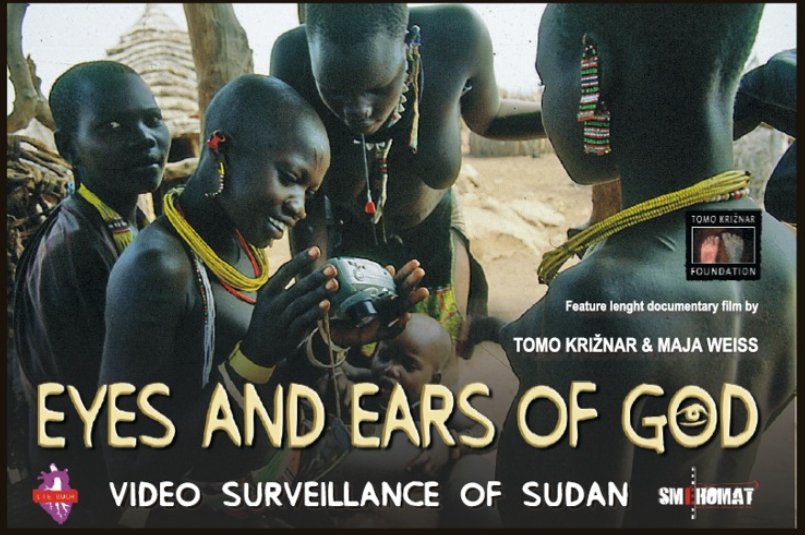
“Eyes and Ears of God – Video surveillance of Sudan” is an eyewitness account by publicist and activist Tomo Križnar from 1979 to 2012 of the secret exterminations of African natives from the areas of Sudan, rich in natural resources: The Nuba Mountains, Darfur, Abyei and Blue Nile. The film is a personal account of what one man can do with the help of like-minded people and friends, who still believe in the power of active commitment and refuse to give in to conformism. The film bears witness to the power of cameras, which can be more potent weapons than Kalashnikovs, and footage that gives the International Criminal Court in the Hague proof of the genocide over the peoples in Sudan. This is a story of the suffering Sudanese, defending their own lives with cameras, computers and satellite modems, and bearing witness to their plight. Forgotten by the world’s politics, media and humanitarian organisations, they are begging the “civilized” world to help them.
The documentary “Eyes and Ears of God” also tells the story of the birth of independent South Sudan and how its secession from Sudan brought about new wars between strategic interests of the world’s powers and both Sudans.
From 2009 to 2012, Tomo Križnar, Suleiman Jamous, the humanitarian co-ordinator of the Darfur rebels, and Klemen Mihelič, the founder of humanitarian organisation H.O.P.E., have distributed over 400 cameras to volunteers across the war zones in the Nuba Mountains, Blue Nile and Darfur. “Eyes and Ears of God” documents the effects of this initiative.
Full-length documentary, 95 minutes, Slovenian and English versions, HDCAM
Production: Foundation of Tomo Križnar in co-production with Bela Film, RTV Slovenija, Studio Arkadena and with financial help of the Audiovisual Fund, Ministry of Culture, Republic of Slovenia
Executive producer: Živa Ozmec Producer: Tomo Križnar Written and directed by: Tomo Križnar, Maja Weiss Camera: Tomo Križnar and 400 volunteers in Sudan Editing: Svetlana Dramlič Original music: Igor Leonardi
Length format: 95 min Production format: DV, PAL, NTSC, HD (16:9) Screening format: HD Languages: Slovenian, English, Arabic, Zaghawa, Fur, Nuba, Komo, Ganza … Production year: 2012