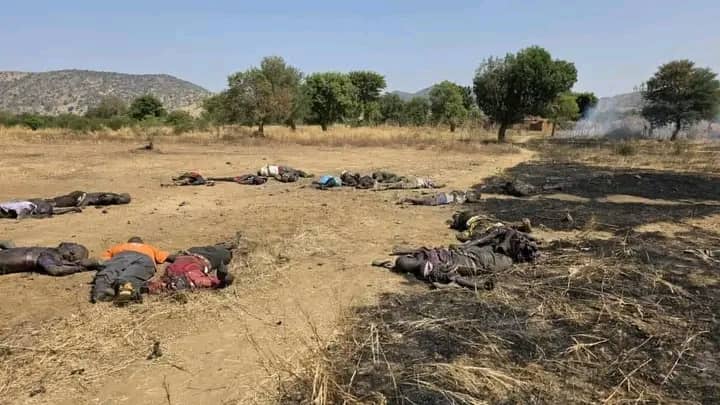
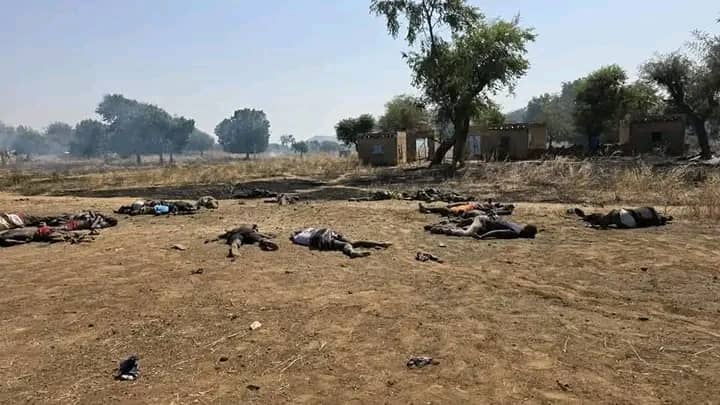
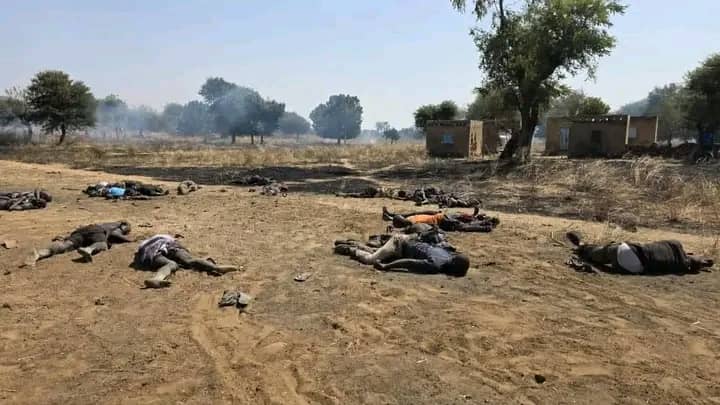
War in Sudan: Humanitarian collapse, fighting, deadlock, December 2025
War in Sudan: Humanitarian collapse, fighting, deadlock, December 2025 Read More »


War in Sudan: Humanitarian collapse, fighting, deadlock, December 2025 Read More »
Women know their mission. Their mothers and grandmothers have passed down to them the experience and wisdom of distant ancestors from the “cradle of humanity.” That is why they still know how to preserve social harmony. They still feel, still remember, and still know how to love their husbands.
And men, too, evidently sense what is right and what is wrong, and remain aware of whom they must defend and for whom they must sacrifice themselves…
They possess almost nothing of what we, their fellow human beings, have in excess. Yet they hold what we—and most of humanity—lack the most.
That is love.
The people in these photographs love one another.
They cherish each other. That is why they are still there.
Love makes them strong.
That is why they are still there.
Because they are strong, they endure in those remote, besieged mountains—hemmed in by the greatest desert and the largest swamps on Earth—without ever being extinguished.
They did not vanish during the darkest era of slave raids, nor when they faced genocide at the hands of militant Islamist authorities (1985–2002), nor when government-backed Rapid Support Forces (alias Janjaweed) began driving them from their ancestral lands into refugee camps—and they have not fled to Europe, even since April 2023, when these two foreign-sponsored armies clashed and they found themselves caught between two fires…
Together with director Maja Weiss and Peter Braatz, in co-production with TV Slovenia and with financial support from the Slovenian Film Centre, we are racing to assist these fellow human beings in Kauniaru through the documentary film “Letter to Europe,” scheduled to premiere in mid-next year, around June.
By purchasing the calendar and planner of the Tomo Križnar Foundation and the humanitarian organization H.O.P.E., you will support the post-production of “Letter to Europe,” as well as through any donation.
Every contribution counts and helps—thank you in advance.
ORDERS: Send an email to tomo.narocila@gmail.com stating that you are ordering the calendar or planner (or both), and include your postal address to which we will send the order with an attached invoice (payment is due upon receipt).
PAYMENT ON DELIVERY:
TRR of the Tomo Križnar Foundation:
SI56 0400 1004 8620 172
BIC: KBMASI2X
(please indicate: calendar, planner, donation)
PRICE:
Calendar: €9 + postage
Planner: €9 + postage
We would be deeply grateful if you could share this message further.
May 2025 be healthy, happy, and compassionate.
Bojana and Tomo
New calendar and planner “WHY THEY ARE STILL THERE” 2026 Read More »
Pope: Cinema is more than a screen; it sets hope in action Read More »
Link to the article:
https://share.google/npUz4NK8RsCUB5v30
The difference between the suffering of millions of fellow human beings in the Republic of South Sudan and tens of millions in Sudan also lies in the fact that, in Sudan, there have been no humanitarian aid flights for two years—and even fewer reports on how people manage to survive.
Phone call recorded during a call from the Nubian Mountains:
South Sudan conflict escalates with increased airstrikes, UN warned Read More »
I myself am unable to offer any political analysis, for the war between two fires – fanned by the most insidious interests of the rest of humanity- repels me to the point that I can no longer put it into words.
Together with my wife Bojana, the director Maja Weiss, and her husband, the director Peter Braatz, we manage, day after day, to push our way through the material for our new feature-length documentary A Letter to Europe, which brings forth the images of the most innocent people, cast upon the sacrificial altar of the world in Sudan.
These are our fellow human beings, those with the greatest right – and the greatest duty – to live and to survive in what may be the gravest crisis of humanism and compassion on Earth.
In our previous film, Rotting 2022, we portrayed leprosy patients in the Nuba Mountains who, without medicine and without any aid program from the World Health Organization, with no voice of their own, were slowly falling apart- victims of the decay of ethics among us in the most privileged part of the planet, where we have everything, except perhaps love, which we seem to have less and less.
In A Letter to Europe, we will show you the love lived by Indigenous people in the most inaccessible mountains – love expressed without words.With love against genocide,
Tomo and Bojana
The US and UAE Are Pillaging Sudan And Crushing The Democratic Aspirations Of Its People Read More »
Dear participants of the meeting on Friday, 16 May, at 15:15, at the Directorate for Development Cooperation and Humanitarian Assistance of the Ministry of Foreign and European Affairs of the Republic of Slovenia,
Please accept my apology for having shouted and gesticulated so traumatically during our first meeting—where we were meant to decide how to allocate the EUR 200,000 that the Government of the Republic of Slovenia has reallocated for assistance to the Indigenous families of the Nuba Mountains, organized within the Sudan People’s Liberation Movement/Army under the leadership of Abdel Aziz al-Hilu.
Because I had only just returned from the greatest humanitarian and refugee catastrophe unfolding today—and because millions of people to whom no aid reaches in Sudan had silently followed me back into my overburdened mind, while I myself have only my mouth and my tongue and so few nerve cells—I am sending you this letter to explain, in greater calm, why we must send assistance not only to the centres, but also beyond them, to places no humanitarian worker ever ventures.
SUDAN IS SHAPED AND DOMINATED BY THE CULTURE OF SLAVE HUNTERS.
Throughout the entire history of our relations with the vast region known as Sudan (in Arabic Bilad al-Sud—“Land of the Black People”), Europeans have repeated the same mistake.
The same mistake is the support of zaribas.
A zariba is a fortified enclosure where traditional slave hunters in Sudan kept enslaved people. Enslaved Africans were captured by Arab, Turkish, European and other slave raiders in regions of Sudan that were once—and remain today—almost untouched by what most white people in the West call “civilisation.”
All economic, military, expansionist and colonial investments were poured into the zaribas, so that captured slaves could be guarded there before being sent in slave caravans along slave routes to slave markets across the Ottoman Caliphate and in Europe.
Most major settlements and towns in Sudan grew out of the zaribas.
We cannot say that the Sudanese towns south of the Sahara that you see on today’s maps—Khartoum, Malakal, Wau, El Fasher, and others—“developed,” because they did not; they simply grew out of the logistical needs of centres for detaining and guarding captured slaves.
The descendants of the slave-owning elites still attempt to control Sudan today.
Sudan is vast—until the secession of South Sudan it was Africa’s largest country. Its size is such that real development outside the centres is nearly impossible: the rural population is sparse, distances immense. Only the descendants of the great slave-hunting clans live in relative comfort, because they invested the profits of the slave trade exclusively in the security of their own centres of power.
The countryside was perceived as an uncontrollable wilderness, and the Indigenous peoples—hunters, herders, and farmers living in the savannahs, mountains, and swamps in symbiosis with wildlife—were regarded as little more than docile or savage primitives.
Slave hunters, in order to capture and trade human beings, first had to dehumanise them—strip them of their basic rights and declare them to be animals.
Animals that one may capture, chain, yoke two-by-two to wooden stocks, and force to march in caravans guarded by askaris—armed men who hacked off the limbs of the exhausted and shot those who tried to escape. They were sold for sexual exploitation, for reproduction, for labour in building “civilisation,” and as janissaries to patrol urban neighbourhoods.
In the culture and economy of slave hunting—which still governs Sudan—foreigners have always invested only in the zaribas because the Land of the Black People is simply too vast and too sparsely inhabited for investment in the countryside to be “worthwhile.”
Floods sweep away buildings in the rainy season; corrugated iron rusts; thatched roofs are consumed by termites.
This same fate befalls every foreign culture seeking to penetrate the Sahel (which old maps uniformly label as Bilad al-Sud).
Colonial Britain called Sudan “The Land of the Great Illusions”—illusions born of limitless horizons, endless time, oppressive heat, and exhaustion, all of which tempt us into believing that everything is possible, that whatever we imagine we can achieve.
In truth, foreigners can do good only if we adapt.
We can adapt to the extraordinary Nature and the extraordinary Indigenous cultures that truly govern Sudan—cultures far stronger than those of the foreign slave hunters who besiege Sudan today, whether in the name of human rights, development cooperation, humanitarian aid, democracy, or the rule of law.
Indigenous peoples in Sudan have resisted foreign domination throughout their entire history. Among them are communities that will not sell themselves for comfort or be deceived by false promises of “civilising missions,” for the experiences of their ancestors have taught them to resist such illusions.
Although global media barely report on Sudan—even less than on Palestine or Ukraine—every reasonably informed citizen of the world knows that the greatest refugee crisis on Earth is unfolding there. What few understand is why.
I, the undersigned, Tomo Križnar, have been studying Sudan by every means possible for nearly half a century. From field experience and conversations with locals and foreign experts deeply concerned for the seventeen million displaced and more than twenty-five million starving—whom UN agencies claim they cannot reach because both warring parties deny them access—I believe I now understand the “root cause of Sudan’s main problem.”
The root cause is foreign investment in the traditional zaribas—whether money, weapons or humanitarian assistance.
Centralisation of power marginalises those outside the centres of provision.
Marginalisation provokes resistance.
The marginalised no longer wish to be abid, zurga—words that in Sudanese Arabic mean slave.
Slaves will no longer remain slaves if they are granted more than what is currently hoarded exclusively in the zaribas.
During the month after my wife Bojana returned home, while I remained alone with 38,000 Indigenous people in Nuba Kauniaro, I could immerse myself even more deeply in their reality.
For our new documentary A Letter to Europe, I recorded interviews with members of the Nuba community in the most isolated, sealed-off, ostracised, besieged and—in relation to the rest of the Nuba Mountains—most marginalised place on Earth.
All of them said:
“We most urgently need and ask for access to drinking water, medicines and doctors, and schools with teachers who will liberate us through knowledge.”
Conflicts between centres and peripheries in Sudan are financed by foreigners for their own interests.
“When two quarrel, the third profits.”
“Killing the slave with the slave” is an even more insidious strategy than “divide and rule.”
“Please—give us peace at last!”
One hundred and seventy-five years after the beginning of the mission of the Slovenian missionary Ignacij Knoblehar in Sudan, and twenty years after President Dr Janez Drnovšek’s peace initiative The World for Darfur, Slovenians are returning to Sudan with the largest contribution so far—EUR 200,000 in development and humanitarian aid.
I understand this as the beginning of the most sincere and morally clean effort to help the most abused and long-suffering people.
Judging from the response to my books and documentaries—through which my co-authors and I attempted to portray the greatest and most innocent victims of the wars for control of Sudan’s natural resources—I know that Slovenian taxpayers expect our assistance to reach those most deserving of it: the people at the very end of the seemingly endless line of those in need in Sudan.
These are the Indigenous communities of Kauniaro, Western Jebels, and Rashad.
This is almost utopian.
But let us at least try.
“We small ones can do what the great ones cannot,” as the late Dr Janez Drnovšek urged.
Let us try—even though we all know everything else would be easier and less risky.
Let us try this in memory of Janez, who dared stand almost alone against the entire world in 2006.
Let us not repeat the mistake we Europeans have made throughout our entire history with Bilad al-Sud—whether unconsciously, consciously, or even deliberately.
At our meeting on Friday at 15:15, I unfortunately did not have the opportunity to describe what I had to overcome on 16 April 2025 while distributing food in the village of Fungor, and how the “hyenas” nearly snatched it from the mouths of the hungriest.
I kindly request the opportunity to give a brief presentation with Bojana and our footage as soon as possible.
Written in haste on a phone—my apologies for any editorial imperfections.
With goodwill and anticipation,
Tomo Križnar, Postojna, Monday, 19 May 2025, 08:11
Phone: 041 936 935
(The WhatsApp/communication exchanges follow; translated faithfully but concisely.)
19/05/2025, 09:51 – Edvin Skrt:
Thank you very much, Tomo! And thank you for your work! We will try to contribute what we can to this mosaic of suffering in Sudan and across the world—305 million people in need every night on this planet.
Thank you also for your efforts and for raising awareness among political decision-makers in Slovenia.
Best regards, Edvin
20/05/2025, 03:14 – Tomo Križnar:
Thank you very much, Edvin, for your reply…
20/05/2025, 03:14 – Tomo Križnar:
Thank you very much, Edvin, for your response. I am deeply aware of the 305 million people in need across the world, for I have spent most of my life searching for answers as to why so many innocent fellow human beings must suffer so unbearably. And why, in the end, so many are left with no alternative but to flee, to starve, to wait and wait… for a salvation that never arrives.
I have personally visited most of the sacrificial altars across the Earth—places where we, the rest of humanity, ritually sacrifice the most innocent among us, much like the Aztecs and Maya once sacrificed lives atop their pyramids. We sacrifice our most blameless human beings so that we might redeem ourselves before the gods, bribe them so that we may avoid penance, and ensure that the sun will return and rise and warm us, shine upon us, ripen our maize, and allow Life to keep growing.
For most of my life I have been searching for answers—what truly lies behind such suffering, and who bears the greatest responsibility for all this unnecessary agony. And why, despite the establishment of the UN Security Council, despite the creation of UN agencies, and despite the allocation of taxpayers’ money to humanitarian and development projects, almost nothing on this planet truly changes.
So thank you, as well, for understanding why I am striving so hard to ensure that at least something—whatever small part we can—might actually be changed now through the support offered by this EUR 200,000 contribution.
Some of my personal experiences and one of my own answers to the question of why the people of Sudan suffer as they do are described in my books Nuba: Pure People (2000) and Oil and Water (2009), as well as in the accompanying documentaries Nuba: Pure People, Darfur: War for Water, Eyes and Ears of God – Video Surveillance of Sudan (2012), and Decay 2022.
During the thirty years of the longest civil war in African history—when, before the secession of South Sudan and the proclamation of the Republic of South Sudan, more than two million people, mostly Indigenous, perished—UN agencies and most NGOs distributed aid exclusively to the central government, the regular Sudanese army, and its militias. In the Nuba Mountains, for example, UNICEF supplied food for children and schools in 64 centres that the government called Dar es Salam—“cities of peace.” I was the first and only foreign reporter who managed to infiltrate the chain of these “pacification centres” surrounding the mountains, where I filmed evidence proving that these were, in reality, military garrisons.
Garrisons of the government army, into which captured Nuba were dragged as slaves, where children were recruited with UNICEF’s humanitarian and development assistance to serve government interests: boys to become janissaries hunting their own peers who remained on the side of the rebels—organized in the Sudan People’s Liberation Army (SPLA) led at that time by its founder, Yousif Kuwa Maki; and girls to serve as concubines and wombs for the birth of children with Arab identity.
The UNICEF leadership in New York responded to my first book and film by sending to Slovenia none other than the former James Bond, Roger Moore, who came to declare that UNICEF does not support concentration camps and that therefore Tomo Križnar cannot possibly be right.
The then State Secretary at the Slovenian Foreign Ministry, Franko Juri, in collaboration with Eva Tomič at the UN Office for Human Rights in Geneva, demanded a fact-finding mission to the Nuba Mountains. Comprising delegates from several states, the group received permission from the Sudanese authorities and landed in the mountains by aircraft.
On the very first day, an incident occurred. Another aircraft appeared in the sky—unexpected. It was a Russian Antonov, the type traditionally used by government forces to drop cluster bombs on Nuba villages. They particularly targeted water pumps, where women gathered in greatest numbers…
The head of the mission stopped distributing chocolate candies and, from a natural outcrop overlooking the valley, called UNICEF headquarters in New York via satellite phone to demand an explanation. The official in New York contacted Khartoum and formally inquired what was happening.
While the bomber circled above us—we all pressed against the granite cliffs, exactly as the Nuba traditionally do when the Antonovs appear—and time seemed to stop, after half an hour the Ukrainian-made aircraft turned and flew off to bomb elsewhere.
The mission participants protested to their leader: “This is not what we agreed to.”
Just as they had arrived and landed on the makeshift airstrip, they departed the next day.
They saw nothing but mountains from above and the path from the airstrip to specially built huts atop the first and only mountain they visited—where armed soldiers kept watch so that no naked, swollen-bellied child, no desperate mother with a limp baby, no starving old man could reach them—because such had been the arrangement.
When Maja Weiss and I received the award for best documentary at the Telluride Film Festival in the United States, the film Nuba: Pure People was seized upon by American activists for Native American and African American rights, who bombarded U.S. institutions with it until Congressman John Denford at the State Department offered himself to President George W. Bush as Special Envoy for Sudan. As a handful of European activists had done before him, he ventured “illegally” under the protection of the rebel army to verify the truth.
Upon his return, he confirmed the reality to the State Department and recommended a complete shift in U.S. foreign policy toward Sudan.
In addition to supplying arms to the SPLA south of the Nuba Mountains, the Friends of the Nuba were established to assist the Nuba in the mountains. In February 2002, at a Swiss castle, they issued a clear message to the world: Sudan was being added to the list of states with which the U.S. would reckon for supporting international terrorism. They secured a ceasefire between the militant Islamic government and the SPLA in the Nuba Mountains—the first ceasefire in Sudan—signed by President Omar Hassan al-Bashir and, on behalf of the SPLA in the mountains, Yousif Kuwa Maki.
Only when professional military monitors began supervising the ceasefire did enough decision-makers within the UN finally understand that providing aid solely to the centre—and solely to one side—was, in effect, assistance in the sorting and partitioning of human beings.
In conditions of hunger, thirst, general deprivation, and the absence of all schooling, humanitarian and development assistance to only one side in the war has the same effect as distributing weapons and ammunition. It colludes with the policies of “divide and rule” and “kill the slave with the slave”—the most insidious and shameful participation in genocide against the most innocent Indigenous peoples.
UNICEF and other UN agencies only joined German Emergency Doctors, Christian Aid, Slovenian Caritas, Italy’s Amani, and the grassroots Indigenous organisation NRRDO (Nuba Rehabilitation, Relief and Development Organization) once genuine peace prevailed in the mountains.
Which, of course, could not last, because…
Enough! I must stop here. I apologise for the length. I have condensed this entire history because I do not expect that you have time to read all our books and watch all our films.
In the hope that you now understand why it is so crucial to send assistance not only to the centre of the Nuba Mountains—the Mother of Mercy Hospital in Gidel, with Dr Tom Catena and the staff treating leprosy patients brought in by Sister Anita Cecilia from the most inaccessible peaks using a vehicle purchased with donations from Slovenian Catholics in Carinthia, the Slovenian missionary station in Ljubljana, and participants of the concert following the premiere of our film Decay 2022—but also to those most endangered, most neglected, forgotten by the world, and marginalised even by the Nuba themselves: the people of Kauniaro, Western Jebels, Rashad, and Blue Nile.
The centre of the Nuba Mountains, Gidel—home to the Mother of Mercy Hospital—and Kauda, the largest settlement on SPLA-North territory under Abdel Aziz al-Hilu, constitute the principal centre in the mountains.
This centre has already grown to resemble a Sudanese zariba.
A Sudanese zariba is a fortified and best-protected place where slave hunters concentrated enslaved people; today it represents a centre in which all power and all development and humanitarian assistance are concentrated relative to the periphery.
Such assistance divides Indigenous peoples into the privileged and the marginalised—driving them into opposition and, potentially, into future wars even within the Nuba Mountains.
I am convinced that we do not wish to help in the manner colonial officials of European empires once helped—and still help—Indigenous populations.
Therefore I beg you: let us undertake the difficult task of ensuring access to drinking water, healthcare, and schooling also in Kauniaro, Western Jebels, Rashad, and Blue Nile.
I apologise for the missing diacritics and any punctuation errors—these letters were written on a phone and outdoors, where I can best heal my soul…
Tomo Križnar, Tuesday, 20 May, 06:24
23/05/2025, 21:55 – Edvin Skrt:
Tomo, your arguments—that aid must reach the most vulnerable in order to protect their dignity and even their lives—are entirely well-founded. Thank you for everything you have written; I have also read your latest book and seen all your documentaries and many of your interviews.
This week, on the margins of the European Humanitarian Forum in Brussels, I met with one of the highest representatives of Trócaire and asked whether they could do everything in their power to ensure that Slovenian assistance reaches the four villages you highlight. She assured me that they will make an additional effort. We will keep you informed if this succeeds; otherwise, we will strive to make it so in the future.
Safe travels to Ukraine,
Edvin
Discover the beauty of the Nuba Mountains and help preserve lives.
The photographs featured in the calendar and planner, arranged by month, capture the striking beauty of the indigenous peoples of the Nuba Mountains. They were taken in January 2024 in a region scarred by decades of foreign wars—wars waged with the backing of Sudan’s government forces and mercenary Janjaweed militias, bent on exterminating native communities and eradicating yet another of humanity’s last seeds.
On the back cover, we present several images of the first English colonialists (digitized from archives at Durham University Library). Their brutal exploitation and abuse of the indigenous population sowed the seeds of today’s SPLM army—composed of fathers, mothers, and children from Nuba families—who fight solely to protect their loved ones.
The oft-repeated truth that the Nuba must be safeguarded—because their preserved values of “being human” and their wisdom of survival may help rescue the “consumerist, modern, dulled and derailed human”—is underscored by photographs taken this October. These were captured during Tomo’s arduous journey through the Nuba Mountains, accompanied by his daughter Maja Križnar and niece Živa Ozmec, immediately after the rainy season ended. Their ultimate goal was to affix I feel Slovenia stickers to a transport vehicle purchased with your donations following the screening of the film Decay 2022. This vehicle has finally reached the Nuba Mountains, enabling the transport of leprosy patients to the Hospital of the Mother of Mercy. The mission would have failed without the constant, selfless assistance of passing locals, who rescued them repeatedly as engines sank into mud and torrential downpours struck without warning.
Proceeds from the calendar and planner will support:
Every contribution counts and makes a difference—thank you sincerely.
Send an email to tomo.narocila@gmail.com. Please include your postal address so we can dispatch your order with an enclosed invoice (payment is due upon receipt).
PAYMENT ON DELIVERY:
TRR – Tomo Križnar Foundation:
SI56 0400 1004 8620 172
BIC: KBMASI2X
(Please indicate “calendar, planner” in the payment note.)
PRICE:
Calendar: €9 + postage
Planner: €9 + postage
P.S. At the link below, you can view several artworks that remained after previous charity auctions—perhaps they will inspire a New Year’s gift:
https://drive.google.com/file/d/1O6zY1O1_zHVLi2mE6CRRK-cNLokiej_v/view?usp=sharing
We would be deeply grateful if you could share this message further.
May 2025 be healthy, happy, and compassionate.
Bojana and Tomo
Calendar and Planner “NO WORDS 2025” Read More »
Dear friends,
It no longer seems that only the Jews are the chosen people—especially not when we look toward Palestine. Nor does it appear that Jesus is the sole son of God—especially not when we look toward Ukraine.
If we turn our gaze to Sudan, we can see that we are not only sons of God, but daughters too. All of us.
Look to Sudan, and listen to Alex de Waal on Democracy Now:
According to UN agency estimates, ten million people are fleeing war in Sudan. More than twenty-five million are in immediate need—not on Monday, but now—of food. The UN World Food Programme is appealing for 2.5 billion dollars in donations, yet reports having received only five percent of that amount. UNICEF warns that by the end of the dry season, 240,000 children will die in Sudan unless…
Professor Dr. Alex de Waal is regarded as the foremost expert on Sudan. In 1997, as a young idealist, he persuaded the BBC to charter a plane and smuggle him illegally into the besieged and sealed-off enclave of the Nuba Mountains, which had been inaccessible to anyone—including journalists—for four years due to civil war. He did not bring weapons, but five cameras, which he distributed to the first five local volunteers to begin documenting crimes against humanity for the International Criminal Court in The Hague. For African Rights, he authored Nuba of Sudan: Facing Genocide, a book that remains the bible for all who care about the suffering of innocent indigenous people.
Watch my address at the World Congress of Professional Congress Organisers (IAPCO) following our most recent return from Sudan on March 1st:
Together with Bojana and Ivan Cores, we were the last to film 480,000 internally displaced people who, since the outbreak of war between the Sudanese regular army and the Janjaweed paramilitary militia in April last year, have fled to the liberated territory of the Sudan People’s Liberation Army (SPLA North), led by President Abdelaziz al-Hilu.
Half a million indigenous families, refusing to surrender to domestic and foreign slave hunters—who themselves lack sufficient millet and water until the first greenery—have been burdened with nearly half a million new hungry and thirsty mouths.
Nuban culture does not permit turning away anyone who asks for help—especially not women and mothers with children, who flee there in greatest numbers. The Nuba Mountains, amidst the total chaos engulfing Sudan, remain the only relatively safe region. But the burden is too great. Now, everyone will go hungry. And no UN agency dares or is permitted to intervene.
For seven years, we did everything in our power to summon at least the World Health Organization and document the endless suffering of lepers in the Nuba Mountains in our film Rotting 2022.
(https://www.rtvslo.si/rtv365/arhiv/174964716?s=tv)
To this day, while church bells rattle across Slovenia, the European Union, and the world, we have not succeeded…
May the testimonies and harrowing forecasts of what may unfold in Sudan—shared with you through these links—offer some reflection, should you find yourselves overindulging in potica, ham, horseradish, and Easter eggs today, tomorrow, or on Monday…
Warm regards,
Tomo and Bojana
They are being tortured. They are being crucified. They are being killed. Read More »
January 1st, 2024:
The straw fence indicated the land of two huts, one thatched, the other made with simple blocks of local Saharan sand, straw, and cow dung (if they had any), and a collapsed toilet.
It was impossible to knock on the door because there practically was none, nor could we ring a bell. Instead, we shouted their ancient greeting “Kuvik, kuvik, kuvik” the way we knew: “Hello, hello Dr. Kenda..” and continued until we could embrace our old friend Dr. Kenda. “Fadal, fadal – welcome, welcome,” repeated once a tall, strong, and solid young man, but now Dr. Kenda is adorned only with more or less skin stretched over well-bent bones. One of the reasons is certainly the shoulder injury in 1960 from “Anja Anja” (Snake Venom), when he was wounded and luckily sent for surgery in America by chance.
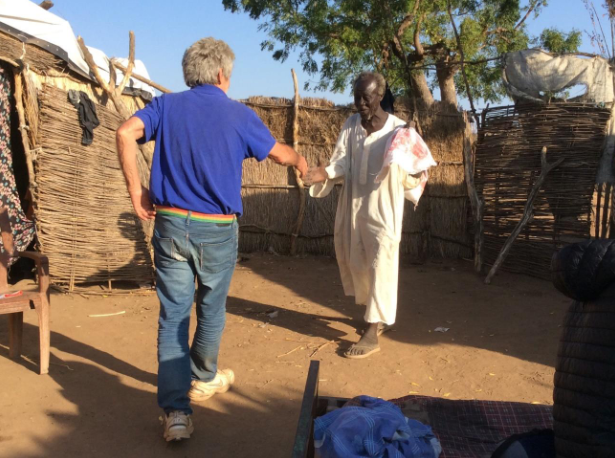
I assume that doctors in the USA recognized his gentleness, inner beauty, and talent, as they did not want to let him leave their ranks; they encouraged him to stay and train to become a doctor. At that time, he was convinced that he had to be a doctor—not only educated but also in perfect condition—and he realized that with such a severely injured shoulder, he would not be able to work with full physical strength. The doctors around him did not give up, and in the end, he agreed to study tropical medicine. In the USA, he completed an eight-year program.
His thoughts, however, constantly returned to the people he had not left of his own free will, to the people who had the luck or misfortune not to have bodies poisoned by increasingly nano-processed food, to avoid traffic chaos, to breathe increasingly polluted air, and to tear their addicted children away from computer or phone screens. Dr. Kenda noticed all of this very quickly, and his heart increasingly longed to return home, to help his people remain in a healthy environment, and to assist them with the knowledge he had gained in the new war that was increasingly flaring up at home.
He returned with a healed, yet still painful, shoulder. The knowledge he acquired in America he continued to refine throughout the rest of his life with new discoveries and insights in the Western Jebels, in the environment where he was born.
His eyes always light up whenever you ask him if it is possible to find many medicinal plants in the Nubian Mountains. “Yes, many, many of them,” he always responds.
Given the completely different vegetation, he had to look for plenty of alternatives, and more and more people were healed with his help. He got married and had eight children.
For his wife, life, where the most common communication is only person-to-person, where there is no electricity, where only your own feet can help you overcome short and long distances and only rarely, if you are lucky, you can be a passenger on some motorcycle or have gigantic wheels of an old tractor turning beneath you, was too exhausting.
She decided that she would find a better life in the capital of Sudan, Khartoum. All information about her was lost. Dr. John Kenda moved with his eight children to the center of the Nubian Mountains, to Kauda. Today, I cannot call Kauda a capital, but I can safely say that Kauda is the main village of the Nubian Mountains, as schools are concentrated here, they even have a university faculty branch from Kampala (Uganda), and all the ministries, since local ministries do exist here.
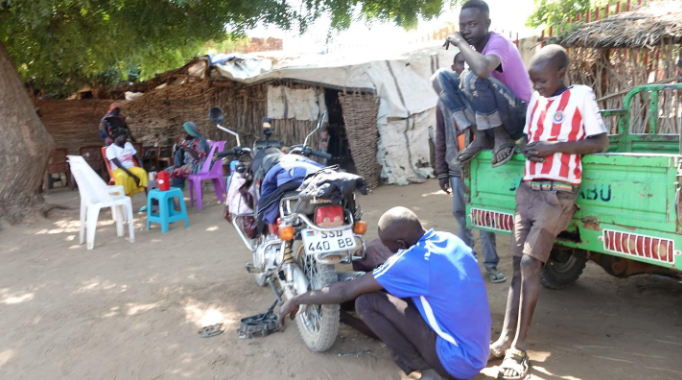
He passed on his knowledge and taught others everything he had learned, right up until May 6, 2011, when he saw Russian Antonov bombers and Chinese MiGs in the sky, and shortly after heard the loud thunder of dropped bombs. The trauma of the attack he endured as a 32-year-old soldier, and the pain in his right shoulder, were too overwhelming for him to stay in another war. Commander Jacot and the supreme commander of the rebel army in the Nubian Mountains, Abdalaziz, recognized at that time his incredible ability to calm people and the knowledge he possessed as a tropical medicine doctor. They knew that his assistance to the people during the war would be very welcome in the refugee camp established on the border with South Sudan by the American humanitarian Protestant organization Samarithan Pruse (Poor Man’s Wallet) and named it the Yida refugee camp, so Jacot took him there.
Everyone knew him; he refused help to no one, even if people came to him without money.
After a few unhappy loves, he met his second wife, Kaka. They married, and they bore him seven children, the last of whom he had at the venerable age of 88.
The situation in the refugee camp, as well as for the highly educated Dr. The kendos weren’t pink. Constant pressure from the security forces of the new state of South Sudan and the United Nations agencies on the refugees with different rules, which at first distributed food to them, gave them land to cultivate, sent them to schools, and then suddenly stopped the distribution of food, restricted schooling, and also banned them from sowing and harvesting. The Nuba were beaten for no reason, Nuba wives were raped, foisted on and accused of various lies and theft. All this because they wanted to relocate them to a refugee camp called Aguangtok, 80 km away, in order to prevent them from returning home to their native village, as they did to care for their elderly inhabitants, who were unable to leave their villages due to disability and malnutrition during the war.
For many years, Dr. Kenda endured all these pressures, and in 2021 he decided to return to the Nuba Mountains, to Buram as the Arabs called him, or Tobo as the Nuba call him.
He started from the beginning, as he had done many times before. He fenced off his new property, built several Nuba huts, a kitchen, a guest room, a treatment room, so that he could take care of a large family and care for patients.
Every year, at least one of Tom and I visited him. This year, the three of us were looking forward to meeting him, in addition to Ivan Cores.
Ivan first visited the Nubian Mountains as a seven-year-old child along with his parents. His father was a renowned Spanish photographer who, among other things, took some of the most recognizable photographs of Pablo Picasso. In the Nubian Mountains, he made historic photographs, especially in two areas of the Nubian Mountains in Tobu (Buram) and in Kauniaru. The Cores family fell in love with the Nubian Mountains because of the special gentleness of the local inhabitants, which is why they stayed among them for four years. This year, Antonio and Elizabeta Cores’ son, Ivan Cores, returned, together with the remains of his father, who before his death had asked that his ashes be scattered in Kauniaru one day, back to the places where he claims to have spent the most beautiful moments of his childhood, after 45 years.
The courtyard was instantly filled with children, all dark-skinned, with big bright eyes and smiling faces; not only did Dr. Kende’s children watch us, but many neighbors also shook our hands in greeting. For Dr. Kende, I first embraced his eldest daughter.
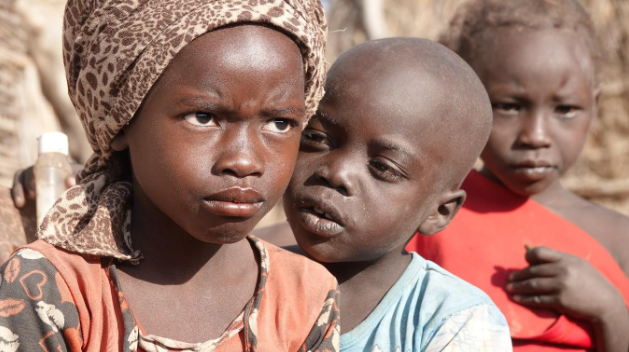
A hug that cut deep. Because I didn’t see Dr. Kenda’s wife in the crowd, I still asked her in the embrace: “Where is mom?” It is impossible to describe how much pain there was in the short but clear answer:
“My mom has died.”
It took quite some time before we spoke again. Only Dr. Kenda, without stopping, began dragging homemade beds out of the huts, frames made of solid acacia wood, and mattresses with carefully woven ropes cut from the bark of the mighty baobab tree. While working, he looked at the ground and repeated like a prayer: “Everything is okay, everything is okay, everything is okay…”.
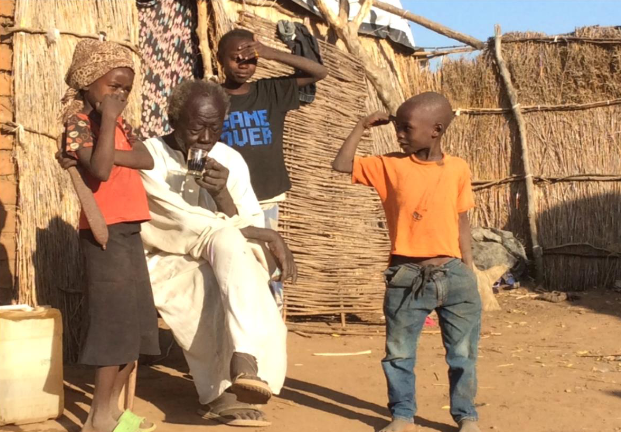
We managed to calm our emotions enough to be able to say goodbye properly. Meanwhile, I kept my gaze on the opening from which our beds had earlier come and hoped that I would soon see Kako – Dr. Kenda’s wife.
“Everything is okay, everything is okay” was heard again from Dr. Kenda. While we were each dealing with our emotions, we didn’t even notice when he went on foot to the market. He went to buy meat for us, but it was already late, so everything had been sold there. He couldn’t be convinced that we weren’t hungry and didn’t need anything. Nevertheless, he instructed his daughter to cook us a wonderful lentil sauce with garlic and to bake fresh bread. I don’t know how she managed to do all this on a small, simple hearth with some embers glowing on the floor, by the wall of the brick-built cottage.
They are careful with fire because last year the youngest son played with matches, and everything burned down.
I watch silently, words are hard to come by; at times, even if I want to speak, I cannot.
Old tragedies are being joined by new ones; fire and in an instant, everything vanished—all that Dr. Kenda had saved over the years. Money vanished, medicine disappeared, all notes, all clothes, furniture…
Kaka’s wife died on May 30 this year. She was allegedly poisoned by the family of the first man she ran away from because he beat her. “Because they were supposedly afraid that she would ever ask them for any money, they poisoned her,” Dr. Kenda recounts with dewy eyes. Everything is ok, everything is ok,” he repeats, laughing and only hanging his head for a moment and staring at the golden-brown sand that still glistens from the sun.
“Now I have to take care of the kids. They ask where Mom is. I tell them she went to heaven. Now they want her,” Dr. Kenda laughs. “They say they want to go to heaven to see their mother.” The smile slowly fades as he continues, “Now I have to be strong, the kids don’t want to eat because they want to go to Mom in heaven. So I have to be with them at lunch and dinner time to eat anything at all.”
From the room, the cry of half-year-old Kodi, the second son of the eldest daughter, can be heard. Crying, he draws attention to the pain caused by his circumcised penis. Dr. Kenda already has him in his arms, carrying him around and comforting him that the pain will soon pass.
Dr. Kenda, Dad, Grandfather and Mom all rolled into one. His next goal is to educate his 15 children, also take care of the daughter his wife had in her first marriage, and her two children. As soon as the journey is safe, he wants to take them all to his native village of Salara in Western Jebels.
Where does such strength come from in a devoted Muslim? The emphasis is on the first part of the question, where does such strength come from? The second part of the text does not play a special role; he could also be a devoted Catholic, a devoted Protestant, a devoted atheist. Faith or no faith? In this case, faith does not play an important role; what is important is that Dr. John Kenda is a person of great Character.
I conclude this note with the hope that each of us could catch a bit of his hope in humanity and the wisdom that it is up to us whether we see life as ugly or beautiful.
GOOD LUCK.
Bojana Pivk-Križnar
Greetings from the Nubian Mountains (January 1st, 2024) Read More »
We are living in pivotal times. The world is being reshaped. In April, a new war erupted in Sudan. This time, those who once fought side by side—committing massacres, ethnic cleansing, and sexual violence against the most innocent indigenous peoples of the Nuba Mountains, Blue Nile, and Darfur—have turned against each other. Over seven million Sudanese have fled their homes. So many, in fact, that neighboring countries—except for the Republic of South Sudan and Uganda—can no longer accept them. No one reports on what is happening at the border with Chad; the latest news suggests that the Mesalit people in Darfur are facing genocide.
Thanks to our volunteers and the communication networks we helped establish, we know that the safest places now are the Nuba Mountains and the Blue Nile. This is largely due to the leadership of SPLA North commander Abdel Aziz al Hilu, who is spearheading a liberation movement against militant Islamic extremists and paramilitary mercenaries (the Janjaweed), who are fighting for control over natural resources and human lives.
In January, before Sudan began to disintegrate, Abdel Aziz al Hilu—after seven years of waiting due to the proximity of government forces and Janjaweed—finally granted us permission to visit the most remote region of Kauniaro in the southeast near the Nile, traveling by motorcycle with guides and armed escorts.
Our new calendar, Humanity and Inhumanity 2024, presents photographs taken by the first European photographers in Kauniaro after World War II, juxtaposed with images we captured ourselves, half a century later.
George Rodger, Leni Riefenstahl, and Antonio Cores were all deeply struck by the unique African culture in Kauniaro, particularly by the ceremonial expressions of love and the worship of sexual energy as a force of universal nature.
What has changed—dramatically—and what has remained unchanged, Bojana and I will attempt to reveal in our upcoming documentary film, A Letter to Europe.
The new calendar by the Tomo Križnar Foundation, Humanity and Inhumanity 2024, offers a preview of what you will see in A Letter to Europe.
We plan to return to Kauniaro before Christmas to complete filming. This time, we will be joined by Ivan, the son of photographer Antonio Cores. Ivan arrived in the mountains in 1977 with his hippie parents at the age of six. They stayed for four years, filming continuously, welcomed by the extraordinarily hospitable indigenous people. Ivan was not educated in a Spanish primary school, but by his Nuban peers. Now, at fifty-five, he will return for the first time to the place he describes as the happiest of his life.
What will he tell us when he confronts the new reality?
If you wish to support our efforts, you can do so by purchasing our calendar and planner. By doing so, you will join our mission to resist the extermination of the most innocent living people—and at the same time, help combat the spiritual decay at home.
The calendar by the Tomo Križnar Foundation and the humanitarian organization H.O.P.E. for the year 2024 can be ordered by sending a message to tomo.narocila@gmail.com. Please remember to include your postal address so we can send you the calendar. You may order the 2024 planner in the same way; both items are available in the attached files.
The calendar and planner make meaningful alternative Christmas or New Year gifts for relatives and friends who have grown weary of traditional gift-giving. Kindly provide their postal address for delivery, and your own address for invoicing. In these times of great trials, we strive to preserve mutual trust and believe you will settle the invoice upon receiving the package.
Price of the calendar: €9 + shipping
Price of the planner: €9 + shipping
Delivery: mid-December
Payment to the Tomo Križnar Foundation account:
IBAN: SI56 0400 1004 8620 172
BIC: KBMASI2X
Please help us spread this message.
Thank you sincerely for your support, fellow travelers.
Wishing you a joyful New Year!
Bojana and Tomo
New Calendar and Planner by the Tomo Križnar Foundation: “Humanity and Inhumanity 2024” Read More »