
Greetings from the Nubian Mountains (January 1st, 2024)
January 1st, 2024:
The straw fence indicated the land of two huts, one thatched, the other made with simple blocks of local Saharan sand, straw, and cow dung (if they had any), and a collapsed toilet.
It was impossible to knock on the door because there practically was none, nor could we ring a bell. Instead, we shouted their ancient greeting “Kuvik, kuvik, kuvik” the way we knew: “Hello, hello Dr. Kenda..” and continued until we could embrace our old friend Dr. Kenda. “Fadal, fadal – welcome, welcome,” repeated once a tall, strong, and solid young man, but now Dr. Kenda is adorned only with more or less skin stretched over well-bent bones. One of the reasons is certainly the shoulder injury in 1960 from “Anja Anja” (Snake Venom), when he was wounded and luckily sent for surgery in America by chance.
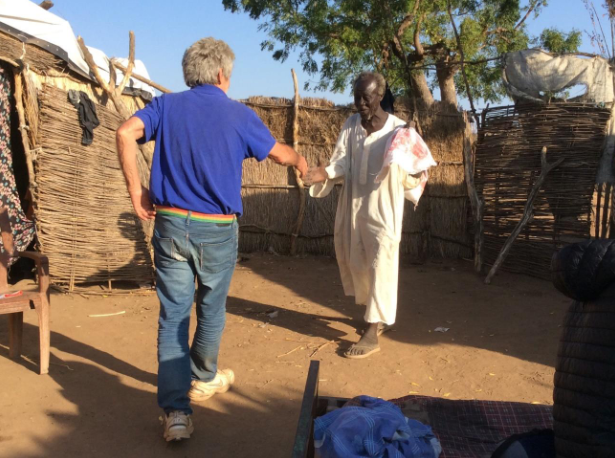
I assume that doctors in the USA recognized his gentleness, inner beauty, and talent, as they did not want to let him leave their ranks; they encouraged him to stay and train to become a doctor. At that time, he was convinced that he had to be a doctor—not only educated but also in perfect condition—and he realized that with such a severely injured shoulder, he would not be able to work with full physical strength. The doctors around him did not give up, and in the end, he agreed to study tropical medicine. In the USA, he completed an eight-year program.
His thoughts, however, constantly returned to the people he had not left of his own free will, to the people who had the luck or misfortune not to have bodies poisoned by increasingly nano-processed food, to avoid traffic chaos, to breathe increasingly polluted air, and to tear their addicted children away from computer or phone screens. Dr. Kenda noticed all of this very quickly, and his heart increasingly longed to return home, to help his people remain in a healthy environment, and to assist them with the knowledge he had gained in the new war that was increasingly flaring up at home.
He returned with a healed, yet still painful, shoulder. The knowledge he acquired in America he continued to refine throughout the rest of his life with new discoveries and insights in the Western Jebels, in the environment where he was born.
His eyes always light up whenever you ask him if it is possible to find many medicinal plants in the Nubian Mountains. “Yes, many, many of them,” he always responds.
Given the completely different vegetation, he had to look for plenty of alternatives, and more and more people were healed with his help. He got married and had eight children.
For his wife, life, where the most common communication is only person-to-person, where there is no electricity, where only your own feet can help you overcome short and long distances and only rarely, if you are lucky, you can be a passenger on some motorcycle or have gigantic wheels of an old tractor turning beneath you, was too exhausting.
She decided that she would find a better life in the capital of Sudan, Khartoum. All information about her was lost. Dr. John Kenda moved with his eight children to the center of the Nubian Mountains, to Kauda. Today, I cannot call Kauda a capital, but I can safely say that Kauda is the main village of the Nubian Mountains, as schools are concentrated here, they even have a university faculty branch from Kampala (Uganda), and all the ministries, since local ministries do exist here.
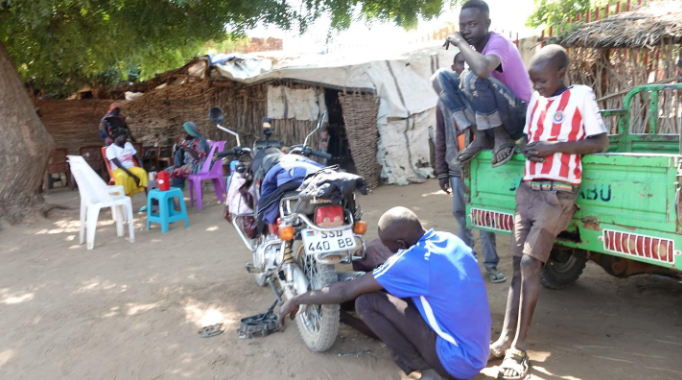
He passed on his knowledge and taught others everything he had learned, right up until May 6, 2011, when he saw Russian Antonov bombers and Chinese MiGs in the sky, and shortly after heard the loud thunder of dropped bombs. The trauma of the attack he endured as a 32-year-old soldier, and the pain in his right shoulder, were too overwhelming for him to stay in another war. Commander Jacot and the supreme commander of the rebel army in the Nubian Mountains, Abdalaziz, recognized at that time his incredible ability to calm people and the knowledge he possessed as a tropical medicine doctor. They knew that his assistance to the people during the war would be very welcome in the refugee camp established on the border with South Sudan by the American humanitarian Protestant organization Samarithan Pruse (Poor Man’s Wallet) and named it the Yida refugee camp, so Jacot took him there.
Everyone knew him; he refused help to no one, even if people came to him without money.
After a few unhappy loves, he met his second wife, Kaka. They married, and they bore him seven children, the last of whom he had at the venerable age of 88.
The situation in the refugee camp, as well as for the highly educated Dr. The kendos weren’t pink. Constant pressure from the security forces of the new state of South Sudan and the United Nations agencies on the refugees with different rules, which at first distributed food to them, gave them land to cultivate, sent them to schools, and then suddenly stopped the distribution of food, restricted schooling, and also banned them from sowing and harvesting. The Nuba were beaten for no reason, Nuba wives were raped, foisted on and accused of various lies and theft. All this because they wanted to relocate them to a refugee camp called Aguangtok, 80 km away, in order to prevent them from returning home to their native village, as they did to care for their elderly inhabitants, who were unable to leave their villages due to disability and malnutrition during the war.
For many years, Dr. Kenda endured all these pressures, and in 2021 he decided to return to the Nuba Mountains, to Buram as the Arabs called him, or Tobo as the Nuba call him.
He started from the beginning, as he had done many times before. He fenced off his new property, built several Nuba huts, a kitchen, a guest room, a treatment room, so that he could take care of a large family and care for patients.
Every year, at least one of Tom and I visited him. This year, the three of us were looking forward to meeting him, in addition to Ivan Cores.
Ivan first visited the Nubian Mountains as a seven-year-old child along with his parents. His father was a renowned Spanish photographer who, among other things, took some of the most recognizable photographs of Pablo Picasso. In the Nubian Mountains, he made historic photographs, especially in two areas of the Nubian Mountains in Tobu (Buram) and in Kauniaru. The Cores family fell in love with the Nubian Mountains because of the special gentleness of the local inhabitants, which is why they stayed among them for four years. This year, Antonio and Elizabeta Cores’ son, Ivan Cores, returned, together with the remains of his father, who before his death had asked that his ashes be scattered in Kauniaru one day, back to the places where he claims to have spent the most beautiful moments of his childhood, after 45 years.
The courtyard was instantly filled with children, all dark-skinned, with big bright eyes and smiling faces; not only did Dr. Kende’s children watch us, but many neighbors also shook our hands in greeting. For Dr. Kende, I first embraced his eldest daughter.
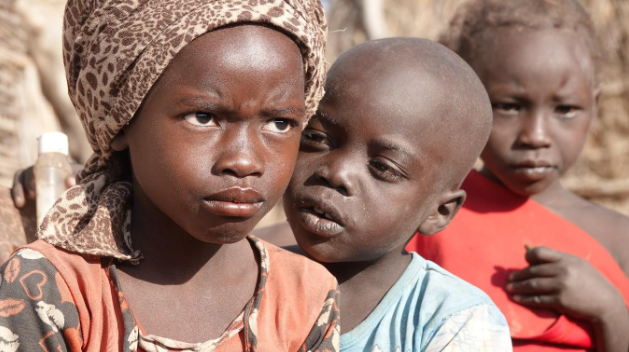
A hug that cut deep. Because I didn’t see Dr. Kenda’s wife in the crowd, I still asked her in the embrace: “Where is mom?” It is impossible to describe how much pain there was in the short but clear answer:
“My mom has died.”
It took quite some time before we spoke again. Only Dr. Kenda, without stopping, began dragging homemade beds out of the huts, frames made of solid acacia wood, and mattresses with carefully woven ropes cut from the bark of the mighty baobab tree. While working, he looked at the ground and repeated like a prayer: “Everything is okay, everything is okay, everything is okay…”.
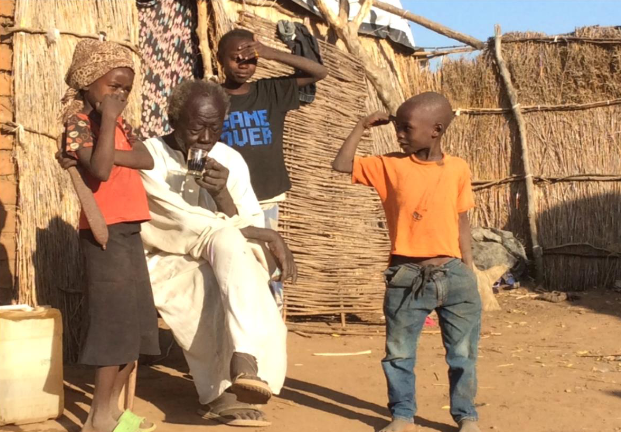
We managed to calm our emotions enough to be able to say goodbye properly. Meanwhile, I kept my gaze on the opening from which our beds had earlier come and hoped that I would soon see Kako – Dr. Kenda’s wife.
“Everything is okay, everything is okay” was heard again from Dr. Kenda. While we were each dealing with our emotions, we didn’t even notice when he went on foot to the market. He went to buy meat for us, but it was already late, so everything had been sold there. He couldn’t be convinced that we weren’t hungry and didn’t need anything. Nevertheless, he instructed his daughter to cook us a wonderful lentil sauce with garlic and to bake fresh bread. I don’t know how she managed to do all this on a small, simple hearth with some embers glowing on the floor, by the wall of the brick-built cottage.
They are careful with fire because last year the youngest son played with matches, and everything burned down.
I watch silently, words are hard to come by; at times, even if I want to speak, I cannot.
Old tragedies are being joined by new ones; fire and in an instant, everything vanished—all that Dr. Kenda had saved over the years. Money vanished, medicine disappeared, all notes, all clothes, furniture…
Kaka’s wife died on May 30 this year. She was allegedly poisoned by the family of the first man she ran away from because he beat her. “Because they were supposedly afraid that she would ever ask them for any money, they poisoned her,” Dr. Kenda recounts with dewy eyes. Everything is ok, everything is ok,” he repeats, laughing and only hanging his head for a moment and staring at the golden-brown sand that still glistens from the sun.
“Now I have to take care of the kids. They ask where Mom is. I tell them she went to heaven. Now they want her,” Dr. Kenda laughs. “They say they want to go to heaven to see their mother.” The smile slowly fades as he continues, “Now I have to be strong, the kids don’t want to eat because they want to go to Mom in heaven. So I have to be with them at lunch and dinner time to eat anything at all.”
From the room, the cry of half-year-old Kodi, the second son of the eldest daughter, can be heard. Crying, he draws attention to the pain caused by his circumcised penis. Dr. Kenda already has him in his arms, carrying him around and comforting him that the pain will soon pass.
Dr. Kenda, Dad, Grandfather and Mom all rolled into one. His next goal is to educate his 15 children, also take care of the daughter his wife had in her first marriage, and her two children. As soon as the journey is safe, he wants to take them all to his native village of Salara in Western Jebels.
Where does such strength come from in a devoted Muslim? The emphasis is on the first part of the question, where does such strength come from? The second part of the text does not play a special role; he could also be a devoted Catholic, a devoted Protestant, a devoted atheist. Faith or no faith? In this case, faith does not play an important role; what is important is that Dr. John Kenda is a person of great Character.
I conclude this note with the hope that each of us could catch a bit of his hope in humanity and the wisdom that it is up to us whether we see life as ugly or beautiful.
GOOD LUCK.
Bojana Pivk-Križnar