Author name: Gregor

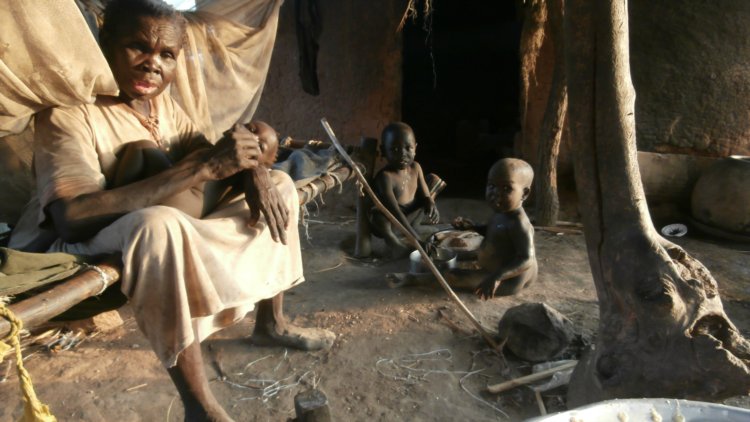
May 2014 – Today’s morning of a Nuba mother with a new-born in her lap

Today's morning of a Nuba mother with a new-born in her lap

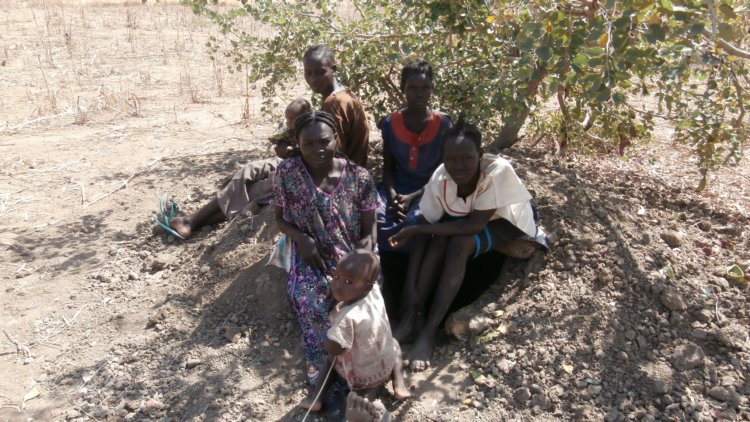
After two days on the frontline in the Kowalib mountains, we returned toward evening to the homestead of our Nuba friend and co-worker Jacob Williams in Kauda. His wife rushed to meet us with a piece of iron in her hands, pointing somewhere around the back of the house. We hurried there and found a hole in the net over the window. A bomb had exploded only a hundred and fifty meters or so away. Almost exactly in the middle of the indigenous Nuba self-help organization, today at around 11:30 in the morning.

Jacob’s wife, with the four year old Kako andbarely eleven days old son, survived in a fox hole next to it.

We were told, in the only humanitarian organization that dares to help in this beseiged and forbidden enclavein Sudan, that nine bombs fell on Kaudatoday. One on the very center of the old, traditional marketplace, another on the ruins of the already almost completely destroyed British colonial school, and the others around this area, the largest place in the liberated territory controlled by Nuba freedom fighters of the SPLA.

This time, the bombshad not dug up large craters – but shrapnel cut up trees andeven the soil almost a kilometer around.

Only one boy was wounded – a little shepherd who gripped an unexploded bomb that slammed into the ground.

Today and yesterday, Russian-made Antonov bombers and Chinese-made Sukhoi Migs dropped bombs and fired missiles all over the Nuba mountains. The locals are sure that this was an act of revenge, since SPLA forces drove the Janjaweed from Daldako in the North-East of the mountains on Saturday, killing one of their important leaders. In Daldako, government forces had amassed most of their heavy military equipment, and most of the news about heavy fighting came from there.

The Janjaweed are mercenaries, hired by the military dictatorship of Omar Bashirin Chad, Niger, Mali and the whole of Sahelto murder, rape and persecute the African tribes of the NubaMountains, Blue Nileprovince and Darfur. The government in Khartoum, which calls them RMF – Rapid Mobile Forces, has confirmed the loss through its media.

Last night, we ended up in the caves at the foot of the granite mountains of the village of Tungole, with missiles exploding all around us. At first light, we escaped higher up into the mountains.

None of us considers himself a prophet, able to predict where it will strike next.

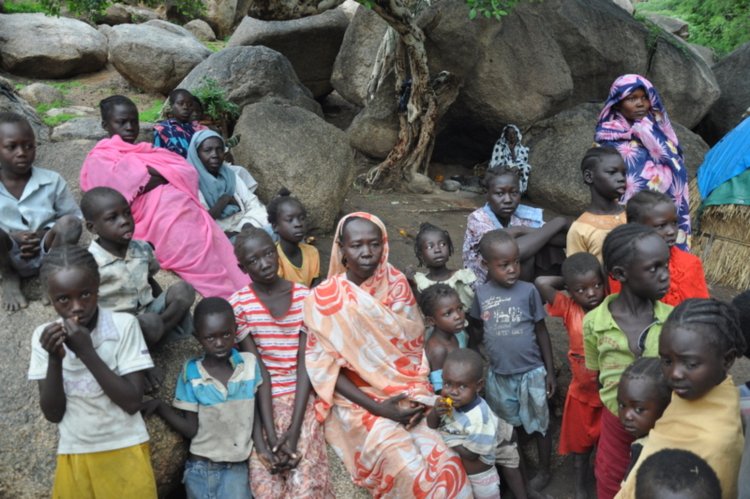
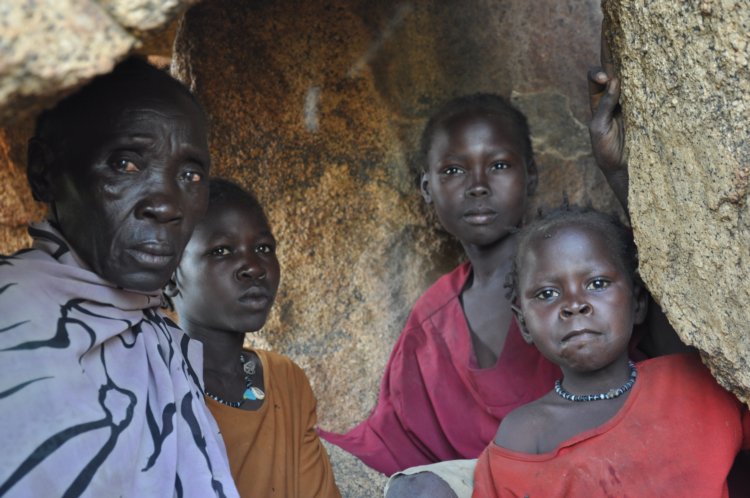
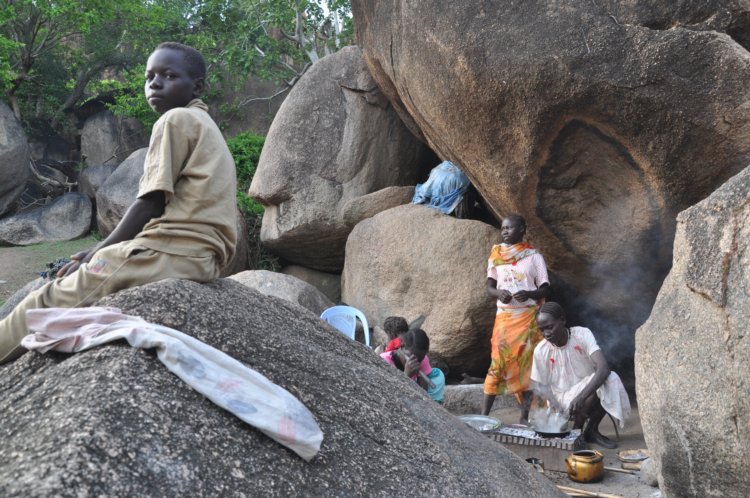
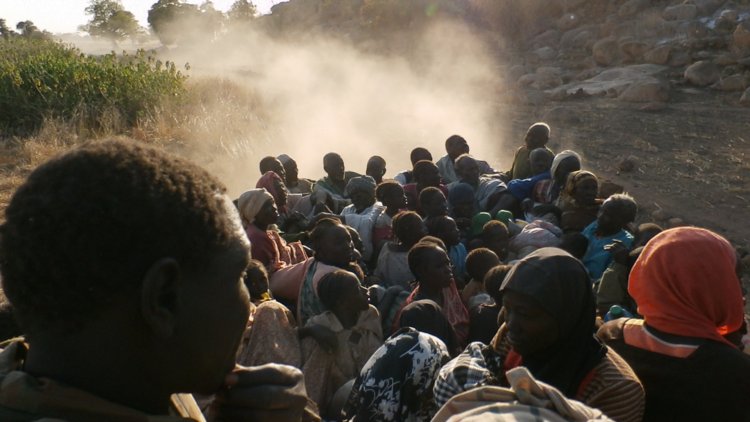
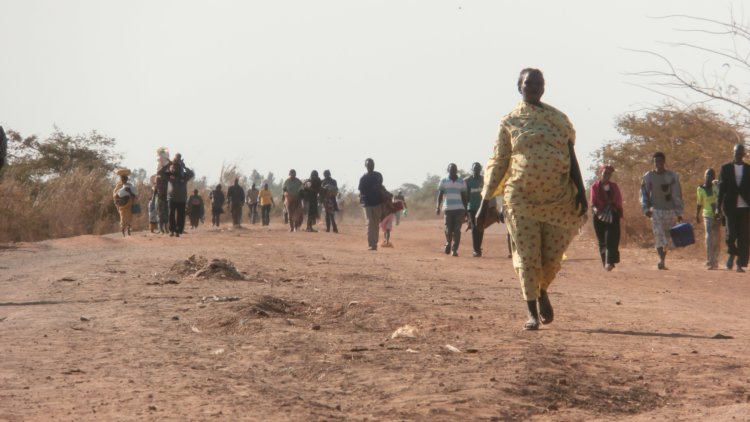
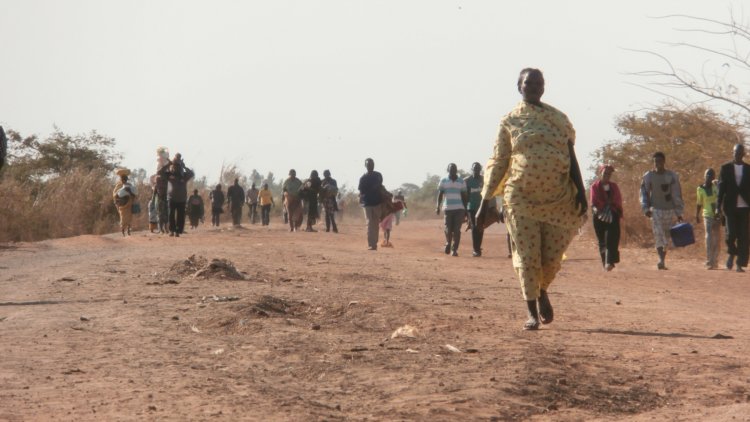
We don’t know yet how many victims there were, though the number of cut-up and killed off refugees, running away from bombers andMigsandmissiles fired from government garrisons into the mountains controlled by the SPLA, is likely to be lower than in previous years, because they have learned, during the three years of war, how to hide in fox holes in the ground by each hut and in caves among graniteslabs at the foot of the mountains and further up. No one could tell me exactly how many refugees sought shelter in the Kowalib mountains – but the many that we had reached testify that there are tens of thousands.

And new ones keep arriving, mostly abandoning their homes and fields in haste and with no possessions.

None of them recieve any sort of help from any international humanitarian organization yet. All these organizations obviously obey the prohibition of access, issued by the military hunta in Khartoum, accused of the greatest crimes against humanity, including genocide.

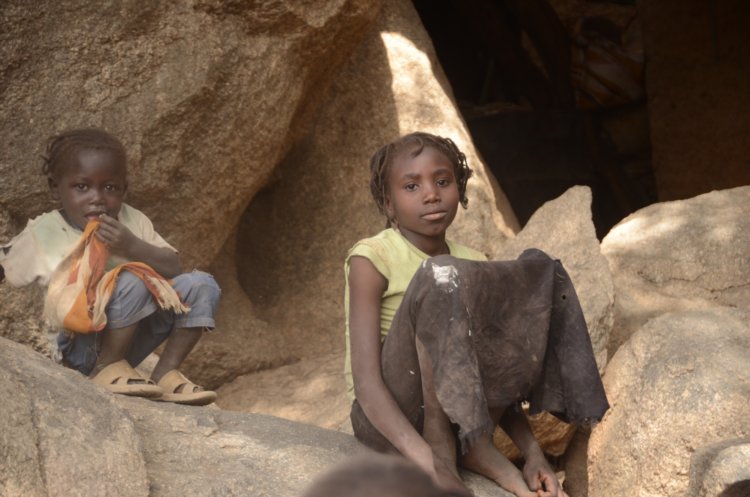
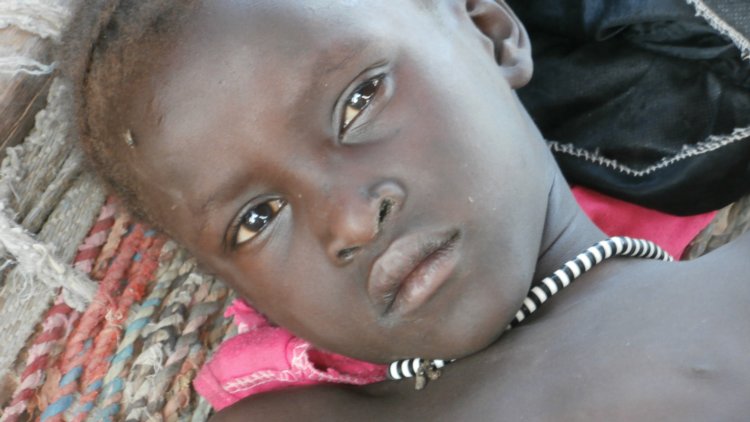
We found the refugees living in a sort of stone age, in the most severe shortage of everything that the modern so-called civilized world boasts of, at the end of their strength. Because of the Arab policy of exterminating the African indigenous people from what remains of the old Sudan, obviously accepted by all international institutions, including the UN Security council and other agencies, they could not sow during the previous rainy season, amid incessant attacks from the air by bombers and Migs and on the ground by the Janjaweed – so they could not harvest either. They are famished and noticeably exhausted, many of them sick. There is not a single doctor among them, and they have no medicines. What kills them most are intestinal deceases and malaria. At the start of the new rainy season that already tortures them with mosquitoes, almost no family has a protective net, or a plastic canopy that in other crisis areas around the world would bear the names of respected humanitarian organizations.I have seen them cook new, young leaves and grass. Their clothing has disintegrated during the last year – higher up in the mountains I saw not only naked children but parents as well. The worst off are of course the elderly. They can not place any hope in the power of goodness.

Last year, at the school in the caves of Tungole, I asked the students and teachers to draw what they saw around them for our 2014 calendar. The principal of the school, with sixteen hundred students and only eleven unqualified teachers, told me that there have been no visits to the school since my last visit, in spite of all our reporting and lobbying. No journalists, no reporters.

“Only God can help us now!” declared the leader of the Kowalib tribe, Kuku Tutu, yesterday.

Tomo Križnar, Kauda, May 26.th, 2014

May 2014 – Today’s morning of a Nuba mother with a new-born in her lap Read More »

Eric Reeves, 28 December 2013: Riek Machar’s End-Game: What is it?

Riek Machar's End-Game: What is it?

Eric Reeves, 28 December 2013

Riek Machar, former Vice-President of South Sudan and current leader of rebel forces in the country, knows as well as anyone that every day that passes without a halt to the fighting-every hour-makes more likely the explosive spread of violence that has already taken on a clear ethnic character. Riek knows as well that as long as this violence continues it will be impossible for most humanitarian organizations to operate outside Juba, putting many hundreds of thousands of civilians at risk-most without any political identity, but inevitably an ethnic identity. The number of those displaced was put at 121,000 several days ago by the UN, but it was only a mechanical estimate. Toby Lanzer, head of humanitarian operations in South Sudan, declared on December 22 that, “‘As we go to bed tonight, there are hundreds of thousands of South Sudanese who’ve fled into the bush or back to their villages to get out of harm’s way'” (BBC, December 22, 2013). There is dismayingly little reporting presence in most of South Sudan, especially in Jonglei, Unity State, and Upper Nile-those areas that have seen the most fighting and in which the forces of Riek Machar are strongest.

Bor (Jonglei) and Malakal (Upper Nile) have been recaptured by the Sudan People’s Liberation Army (SPLA, the army of South Sudan); however, these major towns may yet be the sites of more fighting. Indeed, Associated Press reports today (Nairobi, December 28, 2013) that 25,000 (Lou) Nuer youth are within 30 miles of Bor and that fighting could resume at any time (this figure is likely an overstatement, but perhaps not by much). This would put a tremendous number of civilians at acute risk. Of this Lou Nuer “White Army” Associated Press also reports:

The White Army has threatened the central government in recent past. In 2011 the army said that the Nuer youths would fight until all the Murle-another tribe [in Jonglei]-had been killed.

An unconfirmed report from the ground has the forces of Peter Gadet, who defected to Riek, even closer-at only a few kilometers north of Bor, possibly awaiting the arrival of the “White Army.” Gadet has a well-deserved reputation as a fearsome and brutal warrior.

Two of the states involved in recent fighting-Unity and Upper Nile-are the primary oil producing regions of South Sudan. Machar’s allies control Bentiu, capital of Unity State, and defecting SPLA division commander General James Koang Chuol has declared that the oil fields of Unity have been completely shut down. It is quite unclear whether the shutdown occurred with anything approaching the necessary technical care for such an operation; and given the wholesale exodus of Chinese, Malaysian, and Indian oil workers-including those with technical expertise-it is certain that in the relatively near term, in the absence of maintenance, major damage will be done to the oil infrastructure; moreover, re-starting the flow of oil may be an extended operation. This denies revenues to both Khartoum as well as Juba, given the transit fee arrangements and the significant amount of oil that lies in reserves north of the current North/South border. Oil from the reserves of both South Sudan and Sudan in the Unity/South Kordofan areas use the same pipeline and infrastructure, and are equally affected by any threat to professional maintenance of this system. Riek is also well aware of this.

So why has Riek refused to respond to offers from the Government of South Sudan (GOSS)? These include talks “without preconditions” (December 19), the announced release of most of the detainees Riek has demanded be freed (December 27), and the offer of an “immediate ceasefire” (in a Twitter feed of December 27, the GOSS declared: “We have agreed in principle to a ceasefire to begin immediately, but our forces are prepared to defend themselves if attacked.” Riek’s response? In an interview on December 27, speaking to the BBC by satellite phone, he said “any cease-fire had to be negotiated by delegations from both sides and must be ‘credible,’ must ‘include a way to monitor compliance,’ and ‘must have [established] mechanisms for monitoring.'” But all this will take a good deal of time at a critical moment; and if these requirements are true for a full and final cease-fire agreement, it is not true for an immediate military stand-down. The government in Juba has declared that it will hold off on its offensive designed to re-take Bentiu: this halting, easily monitored, will provide a clear measure of whether the GOSS and the Sudan People’s Liberation Army (SPLA) are acting in good faith, provided that Riek responds in kind. Instead, there are reliable reports of a resumed assault by Riek’s forces on Bor, and my contact in Malakal indicates the SPLA there expects renewed attack.

We could have in effect something very much like the “Agreement on the Cessation of Offensive Hostilities” declared by Khartoum and the SPLA in October 2002-the event that marked the rapid de-escalation of fighting in the civil war, then in its twentieth year. To be sure, fighting continued (as I witnessed myself in January 2003), but the de-escalation continued, leading to a more formalized cease-fire in February 2003. It was this that enabled progress in negotiating the Comprehensive Peace Agreement.

[ Troublingly, it must be said, comments by Juba’s military spokesman, Philip Aguer, are indicative of either a lack of communication or confusion on the part of Juba. Associated Press reports Aguer as saying that, “‘We have not seen any sign of a cease-fire. There is no cease-fire agreed by the two sides,’ an indication the planned assault on Bentiu could still take place” (Nairobi, December 27, 2013). This ambiguity or contradiction or lack of internal communication should be addressed immediately. ]

Machar also declared to the BBC on December 27 that conditions for a truce were not yet in place. But if not now, when? Fighting, violence, and ethnic animosities increase every day, every hour: how can these facts, these “conditions,” not dictate that whatever form of truce or cease-fire is possible be declared now?

What is Riek’s “end game”? How does he see an end to the human destruction that threatens to become utterly catastrophic? How does he see his own future?

Politically he has no apparent allies in the international community, and it is clear from the language of the recent statement by IGAD (a consortium of East African nations, led in this case by Kenya) that there is strong support for Juba:

Addressing a special summit of the Inter Governmental Authority on Development (IGAD), an east African regional body, Kenyan President Uhuru Kenyatta urged Kiir and Machar to seize “the small window of opportunity” and start peace talks. “Let it be known that we in IGAD will not accept the unconstitutional overthrow of a duly and democratically elected government in South Sudan.

Kenyatta continued:

“The present crisis, if not contained, will produce millions of internally displaced persons and refugees and set back this region immeasurably,” Kenyatta told the regional leaders. (Reuters [Juba/Nairobi], December 27, 2013)

The scenario outlined by Kenyatta is terrifyingly plausible. For its part, the African Union is taking its cues from IGAD and the UN has likely done all it can or will do by sending a very substantial new contingent of peacekeeping forces to South Sudan. But even after secession, South Sudan remained one of Africa’s largest countries-the size of France. It will be extremely difficult to control even present violence; to respond to the needs of displaced persons and to provide security for the humanitarian organizations that are desperate to get back into the South is beyond daunting.

Mistrust of Riek by a great many Southerners has always been high, and not only because of his role in the slaughter of Dinka in his 1991 rampage toward Bor, where thousands of civilians were killed. His signing of a wholly unworkable, expedient, and personally enriching peace agreement with the Khartoum regime in 1997 has not been forgotten, and for many that agreement defines him still as a politician. They regard the “Khartoum Peace Agreement” of 1997 (also signed by Lam Akol) as a touchstone event, especially in light of the ensuing massive assault on civilians in the oil regions of what was then Western Upper Nile (which included what is today Unity State). Many more, having had personal contact with Riek, have expressed a distinct uneasiness, a lack of confidence in the man’s trustworthiness.

And yet in an interview with Al Jazeera (December 24) Riek repeatedly declared that he was speaking “for the people of South Sudan,” that he wished for a “palace revolution” that would depose President Salva Kiir, and that his efforts were the start of a “second liberation” of South Sudan. But what form will this “second liberation” take? Riek denied in the interview that he was complicit in any of the terrible atrocities that have been committed, but so long as he refuses to accept an immediate cease-fire, this claim will be impossible to credit.

A Role for Khartoum?

Again, the inevitable question is whether Riek has an “end game” amidst the present violence-or is he simply improvising, counting on a military stand-off that will compel the international community to accord him the place he wants at the negotiating table, and with such military and diplomatic equities as will enable him to strike a deal he finds acceptable?

Unfortunately, the arrangement(s) most recently suggested by Riek (see below) necessarily require Khartoum’s assistance; and in rendering such help, by declaring-with Riek-that the Government of South Sudan is illegitimate, Khartoum would make even wider war all too distinct a possibility. Khartoum’s assisting Riek would be a disaster; nothing could be more destructive of the chances for negotiating the critical outstanding issues between Juba and Khartoum, most notably Abyei, which lies adjacent to Unity State (as well as Warrap and Northern Bahr el-Ghazal). Boundary issues elsewhere would also be impossible to resolve unless Khartoum accepts the GOSS as its sole negotiating partner. The North/South peace would be in extreme danger if any version of such collusion were to become evident.

There are as yet no clear answers or telling insights here about Riek’s intentions; but the march of many thousands of Nuer youth on Bor, in the form of the infamous “White Army,” suggests that Riek is willing to let his forces continue to extend the fighting. Having “let slip the dogs of war,” he has no evident intent to leash them-and “havoc” there will be. Malakal, although retaken by the SPLA, may also be the site of a counter-attack by Riek’s forces, many of them former regular members of the SPLA and a formidable military force.

What is most concerning is Riek’s extraordinary statement about his sequestering of oil revenues (see below). For this raises a deeply troubling possibility: that Riek been in serious communication, even negotiations with the regime in Khartoum, which looks with horror at the shutdown of the Unity State oil fields, with critical infrastructure left unattended by professionals in oil extraction and pumping. The defecting commander of the SPLA 4th Division in Bentiu, General James Koang Chuol, declared on December 26 that “oil production from fields in his [Unity] state had to be halted due to lack of staff remaining at the oil field” (Sudan Tribune). Several days earlier Malaysian oil workers reported that three well sites had already been closed, even before evacuation of all Chinese, Indian, as well as Malaysian workers. The prolonged shutdown of Unity State oil production would be yet another severe revenue shock to an economy in the north that is already rapidly imploding. Last week there were long lines for gasoline in Khartoum, in fear of the oil shutdown. Two weeks before that there were long lines for bread because of an acute shortage, brought on by the inability of the Khartoum regime to purchase wheat from abroad-this for lack of foreign exchange currency (Forex); indeed, according to IMF predictions of last fall, all Khartoum’s Forex reserves will be exhausted by the end of this year. To the extent that oil and transit fees for oil from the South helped to cushion Khartoum from the full effects of its gross mismanagement of the northern economy, their precipitous loss of such revenues may simply be too much to sustain.

Understanding this point full well, Riek and his lieutenants have floated the idea of sequestering oil revenues so that they do not reach Juba; in turn, Khartoum would presumably enjoy the same revenues as before under such an arrangement, and would thus make the regime an ally of Riek and his forces, either de facto or by formal agreement. As Riek himself declared in an interview with Sudan Tribune (London, December 23, 2013):

South Sudan’s former vice-president, Riek Machar, says forces under his command will divert oil revenues accrued from the country’s oil wells, days after his troops seized control of much of the new nation’s oilfields. In an exclusive interview with Sudan Tribune on Monday, Machar revealed a plan to halt oil revenue remittances to Juba. He said no money would go to the government in Juba, explaining that his group plans to divert oil revenues and deal directly with Sudan in implementing the September 2012 cooperation agreements, as they are in control of the concerned states.

In understanding why Khartoum might agree to such a dangerous arrangement we must remember just how desperate the economic situation is in (northern) Sudan, which now rightly fears for its very survival. With inflation poised to skyrocket even further (the real, as opposed to “official,” rate is already well above 50 percent), high unemployment and under-employment, a national currency in free-fall, conspicuous and widespread corruption, and too many sons coming back in body bags, the angry demonstrations of September and October could reappear at any time, as economic hardships only grow. A “solution”-one that might well appeal to those elements in the regime that continue to think the CPA gave away too much to the South-would be a military intervention on Riek’s behalf in Unity State. The point would be to seize the most productive oil regions in northern Unity, in a military alliance with Riek’s forces, and subsequently make a deal on governance and revenue-sharing.

Riek will certainly feel free to make a better offer than Khartoum now receives from Juba. His forces are probably strongest in Unity, where his own Nuer people are the largest ethnic group. But Machar clearly includes Upper Nile (as well as Jonglei) in his plans. And what are the assurances that this revenue will not simply be appropriated by Riek in his return to the existence of a pampered, excessively remunerated warlord? “‘We will establish an extra account to which the oil revenues will be remitted for the economic interest of the people of South Sudan'” (Sudan Tribune, December 23). This is simply preposterous.

In assessing what Khartoum makes of this overture-and it may be this deliberation that prevents Riek from committing to a ceasefire-it is important to realize that the most militaristic and “anti-South” elements predominate in the regime, especially on decisions about war and peace (it was this security cabal that demanded President Omar al-Bashir renege on the agreement of June 2011 to negotiate a peace in South Kordofan, an agreement signed by senior regime official Nafie Ali Nafie). Regard for international opinion among these brutal men is minimal.

So even as we may be sure that the international community will vehemently condemn the regime if it should make an arrangement with Riek in order to secure continued oil revenues (under cover of providing “regional protection”), this is not likely to make much difference. The regime has endured decades of opprobrium without appropriate consequences for its war-making and massive atrocity crimes. These génocidaires believe there is nothing to worry about so long as they retain a monopoly on national wealth and power, both of which are threatened by an economic collapse whose scale they seem not fully to comprehend.

Perhaps Riek’s confidence that an agreement with Khartoum could somehow be fashioned is wholly factitious. But such a scheme does represent a way that Riek might survive long enough to watch as fighting continues in South Sudan, weakening the country sufficiently that his political and military equities become adequate to make him a “peace broker,” thereby ensuring himself a central role in any new government replacing that of Salva Kiir.

This is all hypothetical at the moment. What is not hypothetical is that there is no clear reason for Riek’s failure to respond to Salva’s offer of “unconditional talks” (Riek simply proceeded to declare his own “condition,” the release of all political detainees arrested in the wake of events of December 15). What is not hypothetical is that Riek’s explanation of why he won’t commit to a truce is expedient, and deliberately ignores the ways in which the first steps towards a cease-fire might be taken immediately. The consequence of this failure to commit except in the vaguest terms to a cease-fire makes it likely that the SPLA offensive against Bentiu may soon resume-and it will be a terribly bloody confrontation, for both soldiers and civilians (see IRIN assessment of humanitarian prospects for South Sudan, December 27 – link). Judging by what we have seen of the aftermath of the first round of fighting in Bor, fighting in Bentiu will be even more terribly destructive, and many tens of thousands will be killed or displaced (Agence France-Presse [Juba/Bor], December 25, 2013) (Reuters [Juba], December 28). Toby Lanzer, the senior UN humanitarian coordinator for South, declared on December 24 that:

“I think it’s undeniable at this stage that there must have been thousands of people who have lost their lives. When I’ve looked at the hospitals in key towns and I’ve looked at the hospitals in the capital itself, the range of injuries, this is no longer a situation where we can merely say it’s hundreds of people who’ve lost their lives.” Mr Lanzer also said that the number of people seeking shelter from the fighting was “tens of thousands if not hundreds of thousands.” (BBC, December 24, 2013) (all emphases in quotations have been added)

The official UN count of displaced persons-“more than 120,000”-almost certainly understates, quite significantly, the number of people who have been forced from their homes by violence. Again, on December 22 the UN’s Lanzer declared that, “‘As we go to bed tonight, there are hundreds of thousands of South Sudanese who’ve fled into the bush or back to their villages to get out of harm’s way'” (BBC, December 22, 2013). Daniel Howden, writing in The Guardian (December 23, 2013) reports:

A veteran aid worker, who has been assessing the scale and nature of the killings from sources nationwide, said the real figure was “in the tens of thousands.” On Monday, Machar claimed his forces had gained control of all the major oil fields in Unity and Upper Nile states.

What is all too real is Riek’s declaration that he “represents the people of South Sudan,” and that they would be best served by a “palace revolution” that removes Salva Kiir.

But there is no military solution to the rapidly growing human catastrophe in South Sudan; only a military stand-down will create the possibility of halting the spread of ethnic violence, and it may already be too late. The longer the fighting continues, the more difficult peace becomes and the more catastrophic the consequences for civilians of all ethnicities. To be sure, we simply don’t know enough about conditions in too many locations, especially in Jonglei, Upper Nile, and Unity-the three states in which Riek’s forces are strongest. But surmising from what has already occurred at Bor, Akobo, and Malakal, we should assume the worst.

What is your “end game,” Riek Machar? How do you plan to stop the military violence? Why won’t you commit to a cessation of offensive hostilities agreement? Why are you speaking of the sequestering of oil revenues? And instead of putting a condition on negotiations, with perhaps other to follow, why won’t you accept Salva Kiir’s offer of immediate and “unconditional” negotiations? Why won’t you acknowledge the significance of the GOSS announcement that it is releasing eight of the eleven detainees? Why won’t you work urgently to halt the advance of the “White Army” on Bor, an advance that promises to issue in extremely bloody fighting and guarantees subsequent fighting in Bentiu?

If there are no answers soon, South Sudan may well disintegrate, humanitarians will be unable to assist civilians in need, and ongoing ethnic violence may define whole regions of what is now South Sudan.

[NB: This analysis does not presume to assess the performance of Salva Kiir as president of the GOSS or the nature of political dissatisfaction within the Sudan People’s Liberation Movement. The focus here is squarely on the very recent actions and statements of Riek Machar and their likely consequences for South Sudan. A subsequent analysis will attempt to move back in time in an attempt to survey political discontent in this very new country. The Brookings Institution offers a very useful time-line (“A Timeline of Brookings Expert Commentary on South Sudan,” December 27, 2013
link

Eric Reeves
Smith College
Northampton, MA 01063

Eric Reeves, 28 December 2013: Riek Machar’s End-Game: What is it? Read More »

December 2013 – Turbulent South Sudan: Export in return for genocide

29. december 2013 - Turbulent South Sudan: Export in return for genocide

Article by Tomo, published in Sobotna priloga, Delo newspaper

Soldiers in blue helmets cannot be depended on anymore to save the native population. Nobody is prepared to die for Africans.

Friends from the Darfur rebel group JEM (Justice and Equality Movement) safely drove me and Uroš Strnad on Tuesday, December 17, from the Nuba mountains in Sudan back over the border to the Republic of South Sudan, to the Nuba refugee camp in Jida. The next day, despite the news about clashes in Juba, the capital of South Sudan, we continued the journey without disturbance through the Nuer and Dinka country to Fariang and on to the settlement of Rubkona just before the bridge over the Bahr el Ghazal river and the city of Bentui on the other side, the main administrative and military center that protects the largest oil fields in Unity province. We had no problems on any checkpoint, neither with the Nuer, who are in the majority here, nor with the Dinka, who are the minority tribe. In the same SPLA (Sudan People Liberation Army) uniforms, with the same oil tower logo on rolled-up sleeves, representing Unity province, they monitored, with apparent calm, the infinite level plane separating them from the Arab army from Sudan, stationed in Highli, from where a long, black cloud of smoke was rising up from the north-west to cover half the horizon.

The name of Unity province symbolizes unity, reconciliation, cooperation, prospects. The ambition that peace should prevail on the savannas in the biggest wetlands on the planet, reaching from the mountains on the border with Uganda to the Nuba mountains, on both sides of the Nile. Peace between the African tribes Dinka and Nuer, who have traditionally, throughout known history, battled each other over cattle, and frequently over girls and children too. But in reality, the name of this province in the North of the new, 193.th member state of the United Nations, could not be more misleading.

On Thursday evening, December 19, just before dark, walking back from the UN base to Rubkona, we saw in the sky red flashes of incendiary rockets, falling among the straw huts in the settlement in front of us. Then gunfire and thunder started. Conventional small arms, bazookas, Katjusha rockets, then heavy artillery as well. The road towards the UN base quickly filled with refugees. Judging by their tribal scar marks, they were Dinka.

We knew that the war between the nomadic shepherd tribes spread from the capital Juba not only to the countryside around Pibor, Akoba, Bor, Rumbek, but also to Bentui in Unity province. We heard this an hour ago from terrified passengers of the Sudanese Kush air carrier who could not board their flight. We met them at the reception of the UN base, where we came to ask for air transport to Juba, after the Sudanese carrier Southern Supreme Airlines cancelled the flight in the morning, for reasons unknown.

The passengers-to-be were teachers from Kenya and Uganda, hired to help educate the people in the countryside, where 80 percent of the women cannot read, and they were scared to death. Speaking over each other, they said that as their plane was about to land, on a landing strip some three hours’ drive over the oil fields south of Bentui, angry Nuer suddenly appeared from the bushes and threatened with guns pointing at the sky, until the plane abandoned the approach and flew off again. When the confused passengers boarded a bus, they were stopped at the first checkpoint by Nuer in SPLA and prison guard uniforms, who descended upon them furiously. They shoved them onto the ground, prodded them with Kalashnikov butts, and then began to fire into the ground around their heads. The passengers believed they were finished, but the bullies then began to argue among themselves, because they could not agree on what to do with them. They did not shoot them, as those in prison guard uniforms demanded, but only took from them everything they had of value, and kicked them off back onto the bus. They dragged away with them one of the passengers. A gunshot was heard from the bushes, he is probably dead.

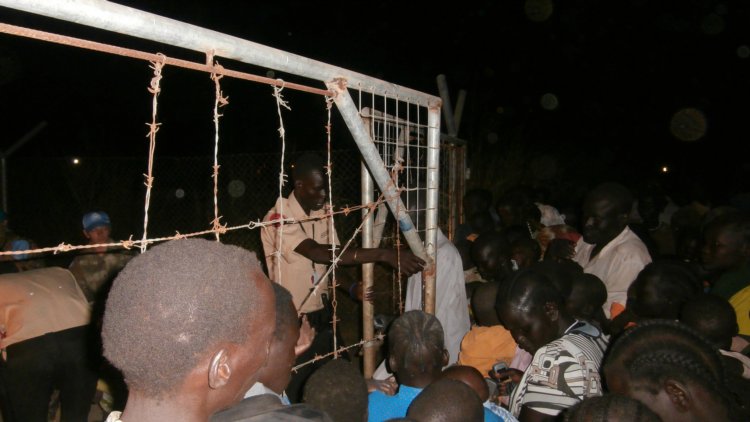
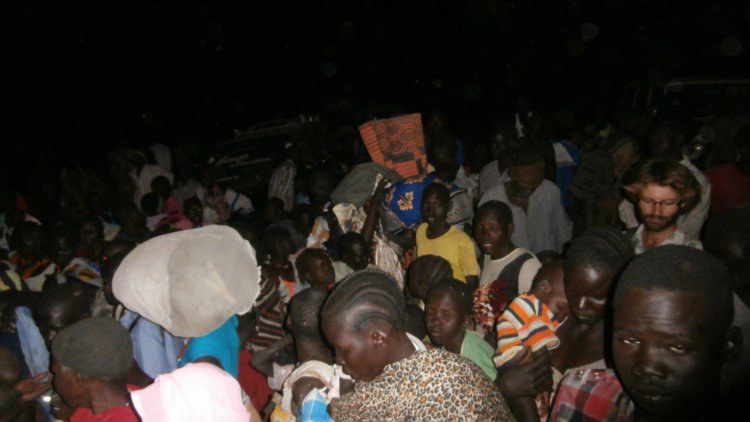
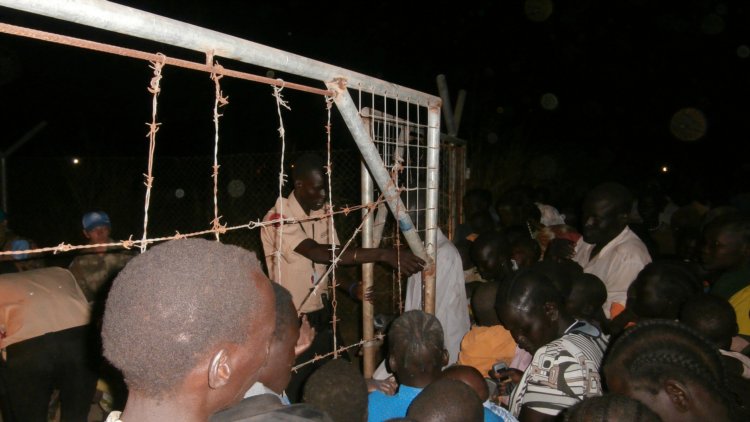
When the sky over Rubkona lit up with red incandescence amid the general gunfire and thunder, we turned back towards the UN base in a column of refugees. This time, the Mongolian soldiers in fortified barricades behind the barbed wire did not let us go back to the reception, but redirected us towards the side entrance. We stepped to the end of a long queue, under nervous searchlights that were constantly scanning lines of bony women in weathered clothes, children, many without parents, as well as men in SPLA uniforms, Dinka with Kalashnikovs in their hands. We waited calmly for the big iron gate that promised safety to finally open. But it stayed and stayed shut.

*****************************************************************

Suddenly, a crying woman with a child in her lap emerged from the darkness and pleaded with us pitifully to go with her. Jalal, the Nuba that I met on the road earlier, translated that the woman is Dinka, that her name is Mariama, that she lives in a hut right next to the base, that her home was attacked a little earlier by Nuer in civilian clothes, who threatened with spears that they will slaughter everybody. Somehow, she managed to hide most of the children in a cesspit and escape to get help.

Uroš immediately asked the Mongolian soldiers who, armed to their teeth, watched all this from an armored vehicle parked on the road, to go with her. At first they didn’t understand, then pretended not to understand, then pretended that they will go to help, and finally really ran, but came back, saying that they have to ask the commanding officer for permission, and began to phone frantically. So, Uroš and I went running after the woman, who was wringing her hands increasingly desperately and crying. That prompted the soldiers to finally move, but slowly and at a safe distance, fanning out with machine guns ready to fire.

As we ran out of the searchlight beams, they stopped again. When they noticed that I was filming them in infrared, the leader covered the camera lens with his hand and screamed furiously, demanding to know who we were. I said we were reporters. He roared about who gave us permission to come here. The government of South Sudan, I said. He calmed down, but meanwhile the woman disappeared into the night by herself. After several tense minutes, she returned with a group of mud-covered and mortally frightened children, who followed her like shadows towards the entrance for refugees.

»You are from Slovenia,« enthused a white woman as we waited until each and every one, except for our new friend Jalal, were allowed to go beyond the fence, after about three hours. »And I am Polish. Don’t worry, you can sleep here. But not with these refugees, we will put you in the conference hall.« »And I am from Bosnia!« boasted a muscular young man in civilian clothes, with a blue UN cap. »We Bosnians know what war is! But who is this?« he asked and gestured at Jalal. »He cannot come with you. He must go with the refugees!« demanded the UN security too, Nuer and Dinka at the reception, as we were registered in the guestbook. It took Ana, the Polish woman, to convince them that he could come with us. Jalal is Sudanese, not South Sudanese, so not an IDP (internally displaced person). Jalal is the new member of our team, so he gets the same rights as we do.

Before we lay down on the bare floor, where some 50 men and women, UN workers from various African countries, crowded, waiting for a plane to Juba, Ana brought two blankets and cans of tuna, cheese, marmalade, a loaf of frozen bread and two chocolate bars. »But don’t let the others see you, I don’t have enough for all,« she said. We ate, hidden among containers, and wondered, shivering from the cold, how many refugee children without blankets will get a cold tonight and die in the open windswept plane where they were pushed by the Mongolian soldiers.

We asked Marco, an Italian. He shrugged and invited me and Uroš to a glass of liqueur, casually ignoring Jalal. »Did you see them?« he blurted, at the table in his container, »who would have thought that such people can still live now, in 2013. Half naked. Like goats! Like a herd of goats!« The sweet liqueur in the mouth suddenly stopped tasting good.

Before we left, he declared that the war was started by a Dinka, the president of the Republic of South Sudan, Salva Kiir, when he fired the vice-president Riek Machar, a Nuer, in October, and on Saturday banned his party SPLA DC too (SPLA Democrats for Changes).

*****************************************************************

In the morning, we asked Ana if we could ride to town with the armored vehicles that had to inspect and assess the damage done during the night. We would film everything, Uroš would immediately edit the footage, the video report about the spread of the war to the countryside would reach the world that very day, like the video reports that we were uploading to the Web by satellite from the Nuba mountains, having trained local volunteers for the task. She replied that that would be absolutely impossible. She must ask for permission the headquarters in Juba, and they in turn ask the blue palace by the Hudson river in New York, where they check every reporter for being too critical of the UN. That would take several weeks. She also said that she cannot get us on a UN plane because we do not belong to UN personnel. We should go on foot to the landing strip in Rubkona and wait for a commercial plane to land.

Since gunfire had apparently stopped, the three of us set out towards the river of refugees that was winding again from Rubkona since early in the morning. When we reached a dilapidated chicken farm just before the first checkpoint, we were received by solemn and somewhat dejected looking friends from JEM, who had given us a ride from the Nuba mountains the day before in a completely different mood.

We found out that the marketplace about two kilometers away had completely burned down, and probably our hotel and our backpacks as well. If they were not burned, they were surely stolen by the Nuer, soldiers and civilians, that hunt and shoot the Dinka all the way to Bentui and further on to the South. Nobody can estimate how many dead there are, because nobody bothers with that. Most Darfur merchants lost overnight everything that they were selling. A number of Somali and Ethiopian women, refugees from their own countries, that were cooking beans and serving tea in the marketplace, were also raped. Nobody is safe anymore.

The trucks and all-terrain vehicles in the yard were already fully loaded. They also rolled up the carpet on which we sat and philosophized about what the new war would bring them. Judging by the tense atmosphere, they were only waiting for the order to retreat back to the other side of the border, to the Nuba mountains, to Sudan.

*****************************************************************

If the Nuer take power in the Republic of South Sudan, nothing will be as before anymore. The former vice-president of the Republic of South Sudan and Nuer tribal chief, Riak Machar, is also known for treason, in the middle of the twenty-one year civil war started by legendary Dr. John Garang, a Dinka, in 1983. This was a rebellion against descendants of slave hunters, Arabs in the North, who helped the British control Sudan in colonial times, and received from them political and economic power after their departure in 1956. Riak Machar, together with Lam Akol, accused Dr. Garang of leading the SPLA too despotically, and rebelled against him. This caused a terrible split within the SPLA, and war between the two tribes that almost destroyed the SPLA and, along with the war against the Arabs, demanded more than two million casualties in both tribes.

Most commanders of the SRF (Sudan Revolutionary Front), which unites African fighters for human rights in the Nuba mountains, Blue Nile and also Darfur in Sudan – after they were abandoned by their SPLA comrades in the South following the secession of the Republic of South Sudan – believe that Akol’s party SPLA DC, disbanded last Saturday in Juba by Salva Kiir, is financed by the military hunta of Omar al-Bashir in Khartoum. And that Bashir’s mercenaries were secretly offering their services to Arab interests ever since the independence of South Sudan was declared. In a new war between the Dinka and the Nuer, they will simply kill each other, by the well-known Arab tactic of »killing a slave with a slave «. Most believe that the goal of Khartoum is to weaken the new state, which it actually regard as war booty, having consented to its independence with a forked tongue, and to take over the oil fields in the South again with help from the Nuer.

The potential victory by Machar’s Nuer might sever the logistic connections to Nuba Mountains and Blue Nile and thus stop the supply of aid, miserable as it is, that arrives in secret over the border from the South. The indigenous African people of Sudan might find themselves similarly isolated as they were between 1993 and 1996, when the Nuba mountains were so closed off that nobody could reach the million and more besieged for three years. Far from the eyes and ears of the world community, the Arabs might finally exterminate the African natives from the mountains where the bones of their ancestors rest.

*****************************************************************

When we inquired about our knapsacks, the leader of the Darfurians set out by himself in an all-terrain vehicle to Rubkona. After an hour or so, he returned with everything that we had left at the hotel, except for my sleeping bag. We could then choose whether to retreat with the Darfurians back to the Nuba mountains immediately, or ask the UN again to get us by air – over all these warring Nuer and Dinka – to Juba, where, judging by the reports, conditions were under control of the Dinka of president Salva Kiir, and then fly to Europe by way of Kampala in Uganda.

Since all mobile communications were disabled, I reported everything to my wife Bojana in Slovenia by satellite phone. She said that Uroš’ mother had already asked Andrej Šter at the Ministry of Foreign Affairs for help with the UN plane. Half an hour later, Šter sent the message that we can return to the UN base: the Slovenian ambassador in Beijing had asked for help, through official channels, the government in Ulan Bator that controls the Mongolian soldiers in Bentui.

As we walked back to the UN base, a convoy of military vehicles headed north passed us by, with Nuer raising their weapons threateningly and letting out wild battle cries.

»We will take you on the next plane,« Ana told us at the entrance. »You can tell that woman that keeps calling from the Slovenian Ministry of Foreign Affairs that she can stop now!« she added firmly.

In order to return at least a little of the favor to the UN, we joined the UN personnel volunteers who were registering the crowd of refugees, many thousand strong by now, pressing into the base. We were given a sheet of paper on which we drew a short line for every man, woman and child that pushed through the tall metal gate. For vertical ones and one across the bundle.

The most pitiful human beings, surviving on the black soil over the largest reserves of oil, were turning into lines in front of our eyes. Not into numbers, as we are used to seeing, but into ordinary blue lines.

By eight in the evening, when the order that we must stop was given, and our soldiers closed the gate and blocked the entrance, a total of 5000 residents of Rubkona, Bentui and the surrounding countryside came through.

Since the canteen was already closed, I went hunting for food for the three of us to the Indians, who are allegedly not very good soldiers, but always have some food. The cook from Himachal Pradesh loaded up two plates of rice with dal and chapatti for me. Then the thundering started again. A siren sounded, our hosts made haste to lock the doors and started to vanish in one direction. Through the darkness, from all sides, columns of new refugees were rushing towards the bunker, this time UN personnel.

I found everybody in five large, strong containers on the west side of the camp.

»If a single rocket falls on the camp, they will evacuate us all!« said a Spanish woman. »In Ruanda, in Srebrenica, on Timor, the same shameful thing happened. The mission is not important, asses are important. The people on whose behalf so many UN mercenaries make a good living are not important at all,!«

Around midnight, when the rocket fire stopped, the three of us returned to the conference hall.

*****************************************************************

»Yes, evacuation!« confirmed a Ukrainian in the morning. »All base personnel will be evacuated.« »If all goes well, you will be in Kampala today!« also confirmed Ana.

After much contradictory information, I found myself with Uroš and Jalal at two o’clock in the afternoon in a UN plane on the landing strip in Rubkona.

In Juba, after settling in right next to the airport in the largest UN base in the Republic of South Sudan, which looks like a city within a city, we met our friend Josef from Slovakia, the UN chief of security, in a modern restaurant. He invited us into a white all-terrain vehicle and drove past security to where he was not supposed to: the 20.000 refugees who were exiled to the west part of the base, where they literally squatted and walked on each other. »Tomorrow we will start distributing food to them!« he said and looked away. »After a week, you will only start to distribute food tomorrow?« »The main thing is, they have water! And security from day one!«

»Do they really have security?« He confirmed what we heard from an Indian in our container, that in Akobo the Nuer broke into the UN base and killed 17 SPLA soldiers. They were all Dinka.

»In Darfur, the hybrid made from soldiers of the UN and the African Union, does not have a mandate to protect the population, but only an observing function.«

In Akobo, Nuer also killed three Indian soldiers.

A friend, working for a Slovak oil company in Bentui, reported that the Nuer broke through the fence, beat up the Slovaks, and then shot all the Dinka they could find right before their eyes.

The commander of the 14.th SPLA division, general Kuong, has just won the war in Bentui against general Deng, the province governor and Kiir’s supporter. This means that the largest oil fields in the Republic of South Sudan are already under Nuer control. The rebels against the Dinka were also joined by the notorious Peter Garet and Jao Jao from the Murle tribe. Together, they also conquered Bor in the morning. In the local UN base, several thousand merchants from Uganda tremble for their lives. During the evacuation of American workers, two planes were shot at, so they were unable to land.

In Juba, the first mass graves were already discovered. Similar news arrive from other places around the country.

Before flying off in the morning, we handed over to Josef two unused airplane tickets Bentui-Juba; we asked him to give them to our friend Nehmedin, a refugee from Blue Nile, who had always helped us smuggle cameras and satellite links to Nuba Mountains and Blue Nile. Because of the police curfew, we could not meet during the night. He told us on the phone only that SPLA soldiers, Dinka, drove over his modest home of bamboo and sheet metal in a tank on Tuesday and stole the motorbike that he earned working in an electronics shop. »Merry Christmas and a happy New Year,« was all I managed to hear before the battery ran out.

*****************************************************************

A year and a half after the independent state was declared, nobody can really control anymore the millions that were lied to and insulted, that were promised by foreign wheelers and dealers of peace that if they vote for secession from the North of Sudan in the referendum, a new, better life awaits them under the protection of western lobbies.

The peace agreement, signed by Omar al-Bashir and Salva Kiir in 2005, after the longest African war, after two million dead and five million exiled to refugee camps, brought the natives nothing, except in Juba. In the countryside, no schools were built, no clinics, no jobs were created. Most of the billions of dollars and euros of US and EU aid, intended for development and advancement, were stolen by the masters in Juba and possibly abroad as well.

Over the last 500 years, we »civilized« people have practically exterminated the indigenous populations of all continents. Sudan remained the most indigenous; neither the Arab slave hunters nor their western colleagues succeeded in hunting down or finishing off the native people, accustomed to all kinds of evil.

It is no longer possible to rely on soldiers in blue helmets to save the natives, even if the UN Security Council dispatches additional 5.000 soldiers. Since nobody is prepared to take a risk and die for the Africans, robots might help – drones with cameras, offered by UN units in Congo, who use them since June to monitor coltan mining areas. Word is that precisely because of this surveillance and monitoring technology, violence against the civilian population has really decreased.

I don’t believe that the supra-national corporations that are taking over the world intend to deploy »flying cameras« in Nuba Mountains, Blue Nile, Abiei and Darfur too, the provinces that were already sacrificed before the comprehensive peace agreement was signed.

The Nuba are not warrior nomadic cowboys like the Nuer and the Dinka. They are farmers who believe that they will reap what they sow.

Over the last two months, my wife Bojana, Uroš and I filmed statements by keepers of the sacred ancestral lands, which make it abundantly clear that they are ready to die rather than surrender. The families in caves around burned down mountains and in foxholes near every home calmly wait to see what the blocked connection with the South will bring them. On behalf of them all, Jacob Wiliams, volunteer videographer in the Nuba mountains, only pleads, by satellite link and Skype, that we don’t forget that they are nevertheless, despite all the arrogance and willful ignorance of the global community, still part of humanity.

We who know what is about to die and what harm this is doing to humanity, join their plea.
Tomo Križnar, Kampala, December 24 2014

December 2013 – Turbulent South Sudan: Export in return for genocide Read More »

December 2013 – Protest letter: Let Us Stop the Genocide of Indigenous People in Sudan

Protest letter

Let Us Stop the Genocide of Indigenous People in Sudan

we wrote a protest letter, hoping that you will kindly read and forward it to others … and also consider how you might personally help in protecting the indigenous people
(we will be collecting your suggestions for cooperation at the e-mail address pivkbojana@gmail.com)

P.S. We sent the protest letter to the UN Secretary-General Mr. Ban Ki-moon, the UN High Commissioner for Human Rights Ms. Navi Pillay, the Special Adviser on The Prevention of Genocide to the UN Secretary-General, Mr. Adama Dieng, the UN Secretary-General’s Special Adviser on the Responsibility to Protect, Ms. Jennifer Welsh, to individual heads of state, religious leaders, the European Cultural Parliament, media outlets …

We will also ask the global public for help in putting an end to the genocide through the Web community AVAAZ, where you too will be able to sign a petition.

Let us preserve the roots of humanity, fight the darkness with light!

December 2013 – Protest letter: Let Us Stop the Genocide of Indigenous People in Sudan Read More »

16. December 2013 – Attacks on Nuba people

Attacks on Nuba people

17. December 2013 – On 12. December 2013 Tomo Križnar has reported for POP TV 24 ur directly through satellite connection about the tragedy of Nuba people and about daily attacks by army of Omar Al Basir.

17. December 2013 – 16. December 2013 – New attacks on native people. How much more time are we going to keep our eyes closed? Tomo Križnar spent all night and day together with attacked mothers, children, old people and patients in caves and in river’s troughs.

16. December 2013 – Attacks on Nuba people Read More »